
Twice the size of Versailles, this European château remains unknown to most French travellers


Versailles captivates the entire world. Millions of visitors flock there every year to admire the Hall of Mirrors, the royal apartments and the gardens. Yet another European monument far surpasses the famous French palace in terms of sheer size, and very few French people have ever heard of it.
Versailles: a reference with its limits
The former residence of Louis XIV encompasses an exceptional estate. It stretches across roughly 800 hectares, the equivalent of more than 1,100 football pitches. This territory includes the gardens, the park, the Grand Canal, the Trianon estate and the Queen’s Hamlet.
Yet when you compare only the built footprint, setting aside the wider grounds, the French palace loses its crown. Another monument, far less talked about, surpasses it by a considerable margin.
Versailles’s reputation as the largest château in Europe, it turns out, deserves a closer look. The fortress that outstrips it lies in Poland, in the north of the country.
Malbork Castle: a fortress like no other
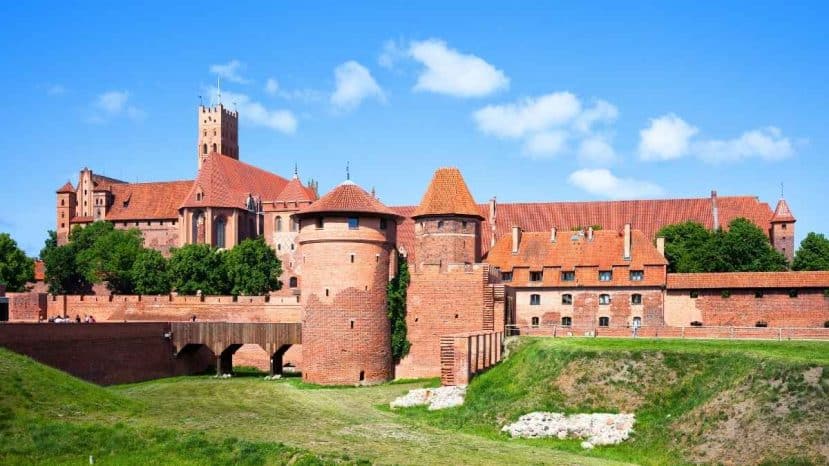
Built in the 13th century by the Teutonic Knights, Malbork Castle covers nearly 143,000 square metres, more than twice the footprint of the Château de Versailles itself. To put that into perspective, the fortified complex spans an area comparable to twenty football pitches.
This red-brick fortress feels less like a residence and more like an entire city. It housed a high castle, a middle castle and a lower castle, complete with assembly halls, a church, living quarters, storerooms and inner courtyards.
“The building was a true military city, capable of housing the members of the Teutonic Order along with their troops.”
A one-of-a-kind red-brick architecture
Unlike the great royal palaces built from stone, this monument is constructed entirely from brick, a material particularly well suited to this part of Europe.
The fortified complex also suffered significant damage during World War II, before being painstakingly restored. Today, it is listed as a UNESCO World Heritage Site.
Malbork thus combines two rare qualities: a monumental scale and a historical significance recognised on the world stage.
- Footprint of 143,000 square metres, more than twice the size of Versailles
- Built in the 13th century by the Teutonic Knights
- Constructed entirely from red brick
- Listed as a UNESCO World Heritage Site
- Located in the city of Malbork, in northern Poland
What you’ll discover inside
A visit takes you through vast medieval halls, inner courtyards and ramparts. The site is open to visitors year-round.
Entry prices are also very reasonable. Expect to pay around 70 zlotys, roughly fifteen euros, for a full visit.
How to get there from France
The easiest way to reach Malbork is to fly into Gdańsk. From there, a train will get you to Malbork in around 30 to 40 minutes.
The city of Malbork sits in northern Poland, making it a perfectly accessible destination even for a short break.
In 2026, this site remains one of the most impressive medieval destinations in Europe, and one that French travellers have yet to fully discover.