This Corsican village of 1,700 people hides a Genoese citadel and a black sand beach
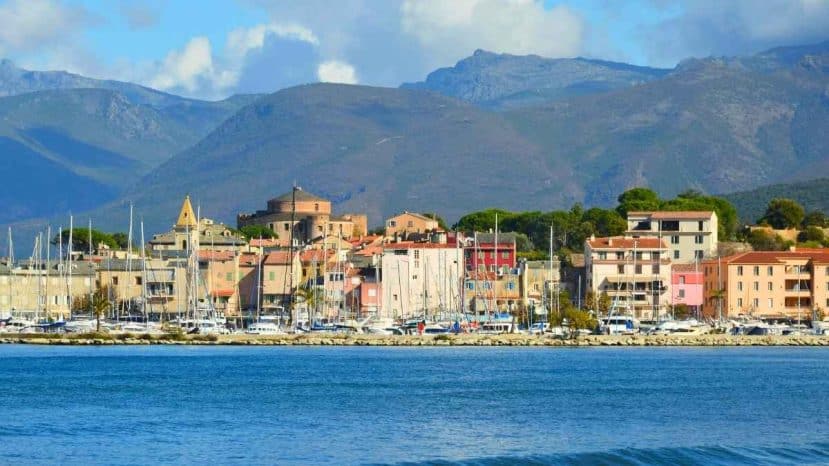


What if your next holiday obsession turned out to be a Corsican village of fewer than 1,700 inhabitants, tucked between sea and mountain, far from the summer crowds? Saint-Florent, in Haute-Corse, is exactly the kind of place you never see coming, and that leaves a lasting mark on everyone who discovers it.
A Corsican village sheltered by its geography
Saint-Florent sits a short distance from Bastia, in the Nebbiu, a micro-region nestled at the western base of Cap Corse. Its position at the back of a gulf gives it remarkable natural protection. On one side, the sea; on the other, the mountains. This particular geographical setting sets the commune apart from the rest of the island while offering an environment of exceptional quality.
This configuration goes some way to explaining why this Corsican village has stayed under the radar. Unlike the island’s ultra-touristy destinations, Saint-Florent maintains a quiet, almost secretive atmosphere. For travellers in search of authenticity, that relative seclusion is precisely one of its most precious assets.
Once the capital of the Nebbiu province, the town was also inhabited during Antiquity. This long, layered past is still legible today in its architecture and heritage, shaped by Genoese and Roman influences alike.
A historical heritage written in stone
Wandering through the streets of this Corsican village means crossing several centuries of history in just a few steps. The narrow lanes, often cobbled, and the colourful façades typical of the south of France create a setting that feels both alive and timeless. Every architectural detail is a reminder that Saint-Florent was, for a long time, a Genoese city of considerable importance.
Above the port, the Genoese citadel of Saint-Florent commands the entire landscape. Built in the 15th century, it offers a panoramic view over the whole region. This historic landmark is one of the town’s highlights: from up there, you can take in the full layout of the territory at a glance, gulf, mountain, and village all at once.
- A unique geographical position at the back of a gulf, between sea and mountain
- A heritage shaped by Genoese and Roman influences
- Cobbled lanes and colourful façades typical of the Mediterranean south
- A 15th-century Genoese citadel with panoramic views
- A charming harbour just steps from the town centre
The harbour and the black sand beach: two faces of this Corsican village
At the water’s edge, Saint-Florent’s harbour is a destination in its own right. Its charm works naturally, without any artifice. It’s the kind of place where you linger, watch the world go by, and soak up the easy Mediterranean way of life that this Corsican village embodies so well.
But the real surprise lies just nearby: a black sand beach, a rare curiosity on the island. This type of beach is uncommon in the Mediterranean, making it a visual and sensory experience that’s hard to forget. For travellers who thought they’d seen everything Corsica’s beaches had to offer, this discovery changes everything.
It’s often in the least-known towns that a holiday takes an unexpected turn. Saint-Florent is proof of that: this Corsican village in Haute-Corse brings together history, nature, and singularity in one place, without ever trying too hard.
Why this Corsican village deserves a spot in your 2026 travel plans
In 2026, more and more travellers are turning away from overcrowded sites in search of destinations that still feel like they can breathe. Saint-Florent answers that need with rare consistency. Its modest size, its sheltered geographical position, and the richness of its heritage make it a Corsican village in a class of its own, one capable of satisfying history lovers and sea enthusiasts alike.
From the Genoese citadel keeping watch over the gulf to the cobblestones of the town centre lanes, by way of the harbour and its black sand beach, every element of this Corsican town has a story to tell. This is not a picture-postcard Corsican village of the generic variety: it’s a place with its own identity, forged over centuries of occupation and Mediterranean life.