
White hair and DIY coffee dye: what it actually covers (and what it never will)
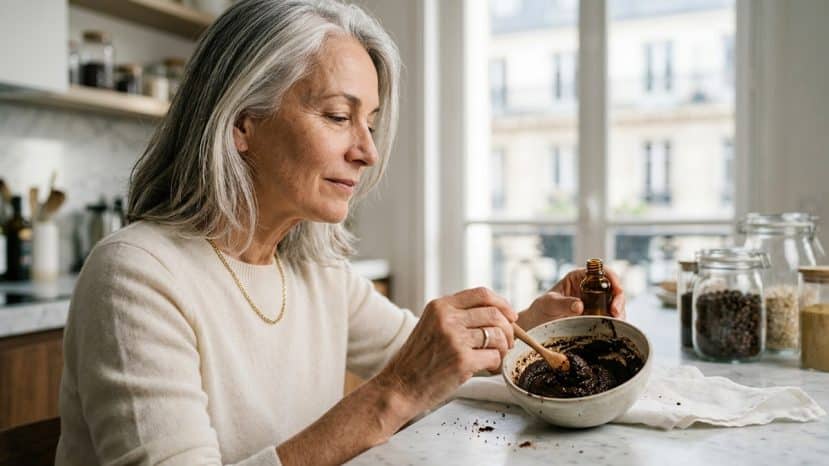


Hiding a few white hairs without resorting to chemical dye is an appealing idea, and one hack is currently making the rounds on social media with a straightforward promise. A very strong coffee, a little conditioner, and your white hair would fade away as if by magic. Before you buy into it, it’s worth understanding what this trick can genuinely do, and, more importantly, what it will never change.
What really happens inside the follicle when hair turns white
Each hair’s colour is born deep inside the follicle, where specialised cells produce pigment. Over time, through stress, ageing, or genetics, those cells slow down and eventually stop. The hair that grows out emerges grey, then white.
This is the crucial point: once those cells have shut down, no product applied to the hair shaft can restart them. Hair is a dead material the moment it breaks through the scalp. As a result, anything applied to the surface, coffee or otherwise, stays at the level of the outer cuticle and never reaches the inner cortex or the follicle itself. Claiming that a home rinse can restore melanin is therefore a misleading statement.
Why so many people are turning away from conventional dyes
To cover white hair, standard permanent dyes rely on a powerful chemical duo: ammonia opens the cuticle scales, and hydrogen peroxide allows new pigments to bond deep inside the cortex. Those pigments often contain PPD, a recognised allergen.
This type of oxidative dye accounts for between 70 and 80% of the European market, according to Santé Magazine. The Anses recorded 124 adverse reactions between 2019 and 2025, including severe eczema and throat swelling. These products are regulated by European Regulation No. 1223/2009 and the ANSM, but their allergenic profile has pushed many people to look for a gentler alternative.
What coffee actually does to white strands
Coffee acts as a surface pigment: its dark compounds settle on the cuticle and slightly deepen the hair fibre. On brunette or chestnut hair, this effect can blur white roots between salon visits and add an overall shine to the hair. The salt-and-pepper look softens visually, with no chemical reaction taking place beneath the surface.
On lighter hair, however, the result is very subtle and can even produce uneven tones. In every case, the colour is temporary: it does not hold like a permanent dye, because no oxidant fixes the pigment inside the cortex. Expecting this method to provide lasting coverage of white hair will inevitably lead to disappointment.
How to prepare and apply the coffee mask
The preparation is simple and costs almost nothing. Here are the steps from the method described:
- Brew a very strong coffee and leave it to cool completely.
- Mix the cooled coffee with two tablespoons of conditioner or hair mask.
- Apply the mixture to clean, towel-dried hair, working from roots to ends.
- Leave on for between 20 and 45 minutes.
- Rinse with cool water to close the cuticle scales.
The process can be repeated two or three times a week. The effect remains subtle, involves no oxidants, and leaves hair feeling softer. That is precisely where the real value of this trick lies: not repigmenting white hair, but improving the overall look of your hair at minimal cost, while you wait for a proper dye job if needed.
What to keep in mind before you try it
Coffee is no match for a permanent dye when it comes to coverage. Its effectiveness remains modest, around 4 out of 10 by the editorial team’s assessment. That said, for people with brown or chestnut hair who simply want to soften the appearance of white strands between professional treatments, this weekly ritual has a very favourable risk-benefit ratio: zero ammonia, zero PPD, zero meaningful expense.
The essential distinction remains the same: camouflaging white hair on the surface, yes. Claiming to restart deep pigment production, no. Understanding that limit means using the trick for exactly what it’s worth, without expecting the impossible.