
Spirotechnique turns 80: the French dive watch taking on Rolex and Blancpain
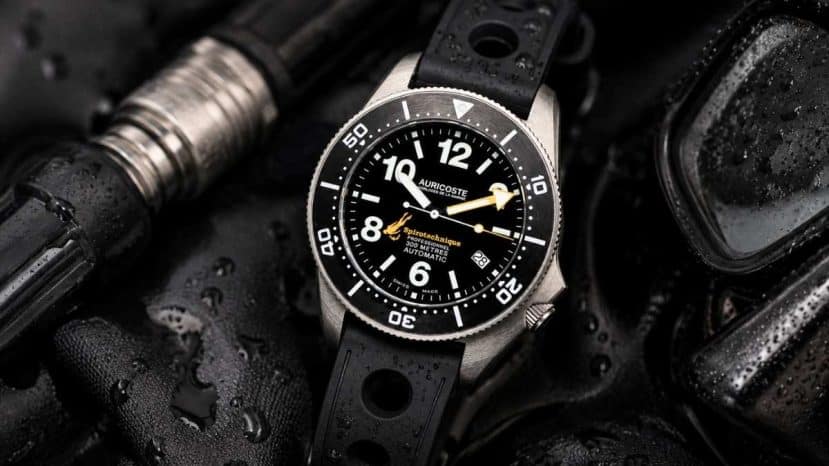


Wearing a watch born from the same adventure as Cousteau’s aqualung, that’s the promise of the Auricoste Spirotechnique. In 2026, La Spirotechnique turns 80, and this anniversary is the perfect moment to understand why this French dive watch holds such a singular place in the history of maritime watchmaking.
From a wartime workshop to the birth of La Spirotechnique
It all begins in December 1942, in a France living under the restrictions of the Occupation. Jacques-Yves Cousteau meets Émile Gagnan, an engineer at Air Liquide. Gagnan is working on a regulator designed for gas-powered vehicles. Cousteau immediately sees how the device could be adapted for breathable air underwater. From that meeting comes the Cousteau-Gagnan regulator, and then the CG45: C for Cousteau, G for Gagnan, 45 for 1945.
In 1946, Air Liquide creates La Spirotechnique. The move goes far beyond simply founding a company. It opens up a market, a practice, and an entire world of possibility. Autonomous diving stops being a heroic improvisation and becomes a discipline in its own right. No longer tethered to the surface by a hose like a deep-sea diver in a helmet, the human body becomes mobile, free to film, to explore, to breathe in a world that was never meant for it.
Cousteau, then, doesn’t just invent a piece of equipment. He creates a new posture: that of the person who descends beneath the surface and comes back with images. It is precisely here that the connection to watchmaking begins to make perfect sense.
When the watch becomes a survival instrument
By the 1950s, diving was placing its own demands on the wrist. A watch had to offer instant legibility, serious water resistance, a rotating bezel, luminous materials, and a case capable of withstanding pressure. It had to follow a person into a hostile environment without failing. It wasn’t there to look good. It was there to get you home.
This is the context in which the great dive watches were born. In 1953, Blancpain introduced the Fifty Fathoms, developed in collaboration with French combat swimmers. That same year, Rolex launched the Submariner, which would go on to become the defining icon of the genre through exploration, professional use, and eventually the cinema and the James Bond myth. Zodiac placed the Sea Wolf in the same founding era. Later, Doxa made its mark with a distinctive orange dial. Omega built the Seamaster into a dynasty. Seiko brought the robust dive watch to a global audience.
- Blancpain Fifty Fathoms (1953): developed with French combat swimmers
- Rolex Submariner (1953): a global icon shaped by cinema and exploration
- Zodiac Sea Wolf: rooted in the same founding era
- Doxa: celebrated for its orange dial and diver-focused ergonomics
- Omega Seamaster: a lineage built over decades
- Seiko: the reliable dive watch brought to a worldwide audience
Within this pantheon, the Auricoste Spirotechnique occupies a genuinely different position. It has neither the worldly glamour of a Submariner, nor the perfectly orchestrated heritage narrative of a Fifty Fathoms, nor the eye-catching colour of a Doxa. It has something else: functional honesty and an immediately recognisable identity.
The Auricoste Spirotechnique identity: the tool before the jewel
Auricoste is a French watchmaker with deep historical ties to the French Navy. The watch it produces under the Spirotechnique name is conceived as an instrument, built for divers, combat swimmers, and those for whom the sea is a field of engagement, not a backdrop. You recognise it by its no-nonsense tool aesthetic, its uncluttered legibility, its steel case, its unidirectional bezel, and its professional spirit. But above all, you recognise it by its iconic yellow diver figure and the La Spirotechnique signature, which carries an entire French diving heritage all on its own.
The contemporary version is water-resistant to 300 metres. It makes no claim to revolutionise watchmaking. Its purpose lies elsewhere: to carry a fragment of French diving history on the wrist. Because this watch was born to serve, and it is precisely that honesty which, over time, has made it desirable in the eyes of collectors and lovers of the sea.
In a watch market often saturated with opportunistic reissues, the Spirotechnique retains a certain roughness. It tells the story of a deeply legitimate maritime France: the French Navy, combat swimmers, Cousteau, Air Liquide, professional diving. What collectors are increasingly looking for is coherence. A name that means something. A maritime lineage. An aesthetic that makes no attempt to please everyone.
80 years of La Spirotechnique: a French story worth (re)discovering
France has often left it to others to turn its technical adventures into objects of desire. Cousteau became a global myth. La Spirotechnique equipped generations of divers. Yet the watchmaking narrative of diving has been written largely in Switzerland, in Japan, and sometimes in the United States. The Auricoste Spirotechnique reintroduces a French thread into that story, a quieter, more discreet one, almost reserved for those in the know.
The 80th anniversary of La Spirotechnique in 2026 deserves to be more than a milestone for an equipment manufacturer. It is an opportunity to bring together Cousteau, Gagnan, Air Liquide, the combat swimmers, and French watchmaking within a single narrative. Before it was a marketing segment, the dive watch was a tool for survival and for mission. To look at the Auricoste Spirotechnique today is to understand that a watch can be more than an accessory: a mechanical memory of French underwater adventure.