Monoprix teams up with the Musée d’Orsay on 23 September, with pieces from €10
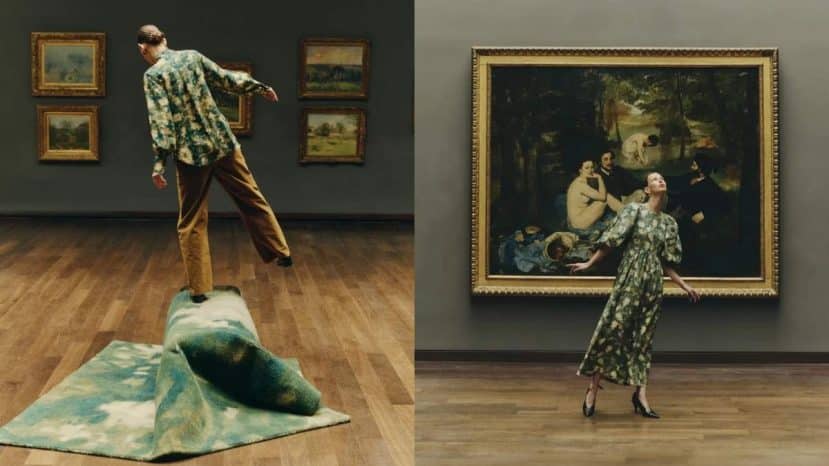


Imagine finding, between the aisles of your local supermarket, a plate in the hues of the Water Lily Pond or a pair of pyjamas inspired by a canvas that only recently entered the collections of a major national museum. That is exactly what Monoprix is making possible from 23 September, with the launch of its very first collaboration with a cultural institution: the Musée d’Orsay.
When Monoprix joins forces with the Musée d’Orsay for its 40th anniversary
The Musée d’Orsay opened its doors on 1 December 1986 inside a former Belle Époque railway station. In 2026, it celebrates 40 years of existence, with a collection of some 150,000 works across all media and the richest Impressionist collection in the world. To mark the occasion, the museum has rolled out a series of initiatives: an evening orchestrated in the nave by Thomas Jolly, concerts, talks with Sophie Calle and Catherine Meurisse, and now this unprecedented partnership with the mass-market retailer.
This is the first time Monoprix has signed a collaboration with a cultural institution. The choice is far from arbitrary: it reflects a desire to make art part of everyday life, right down to the wardrobe and the dinner table. Drawing on the museum’s Impressionist holdings, the brand has created a collection that sets masterpieces in conversation with objects of daily use.
50 pieces across fashion and homeware, from €10 to €280
The collection spans 50 pieces, split between fashion and homeware, with prices ranging from €10 to €280. That breadth of price points means there is an entry into the collection for everyone, whether you are after a small accessory or something more ambitious. The reference works cover a wide sweep of Impressionism and Post-Impressionism: Monet, Manet, Signac, Toulouse-Lautrec, alongside women artists including Berthe Morisot, Eva Gonzalès and Anna Boch.
Among the pieces already generating buzz, the tableware in the colours of Monet’s Water Lily Pond is an immediate eye-catcher, as is the pyjama inspired by Cueillette by Anna Boch, a canvas that entered the museum’s collections as recently as 2024. That last choice is particularly meaningful: it shines a light on a recent acquisition and on an artist who spent years in the shadow of Impressionism’s bigger names.
- Launch date: 23 September
- Where to buy: online, in Monoprix stores and at the Musée d’Orsay boutique
- Number of pieces: 50 across fashion and homeware
- Price range: from €10 to €280
- Artists featured: Monet, Manet, Signac, Toulouse-Lautrec, Morisot, Gonzalès, Boch
Hall Haus, the other Monoprix collaboration worth knowing about
Running alongside the Musée d’Orsay collection, Monoprix has given Hall Haus free rein, a design collective that draws equally on the Bauhaus and hip-hop. The collective first made its name by turning the humble shopping trolley into a collectible armchair, a gesture that neatly sums up its approach: taking the ordinary object and making something unexpected out of it.
Hall Haus armchairs, stools and graphic teapots arrive from 9 September, two weeks ahead of the Impressionist collection. They will be available online and in a selection of stores. For those drawn to modernist design rather than 19th-century painting, this line offers a compelling alternative within the same retailer.
How to make sure you don’t miss the 23 September launch
The Monoprix x Musée d’Orsay collection will go live simultaneously across three channels: the brand’s website, Monoprix stores and the Musée d’Orsay boutique. Given the predictable enthusiasm for this kind of tie-up between a mass-market retailer and a leading cultural institution, moving quickly on launch day will be essential.
The pieces inspired by women artists, Berthe Morisot, Eva Gonzalès and Anna Boch, deserve particular attention. They signal a clear intention to spotlight figures who have long been under-represented in major retrospectives. In that sense, this collection does more than reproduce the museum’s greatest hits: it also chooses to champion recent acquisitions and less-publicised perspectives, giving it a genuine editorial coherence that goes well beyond the decorative object.