
The worst mistake is trying to go back to your original colour” on grey hair
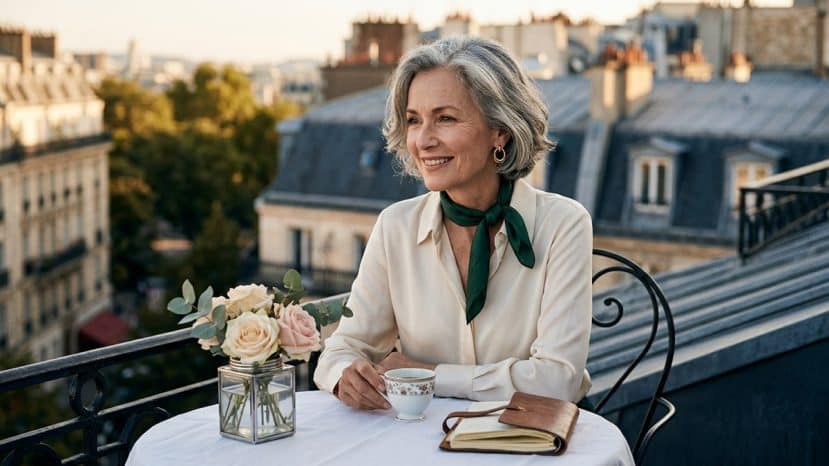


Every morning in front of the mirror, the same question surfaces: should you cover those silver strands or learn to embrace them? For many women over 50, the reflex is immediate, mask the grey hair by recapturing the dark shade of their twenties. Yet according to celebrity hairdresser Fabien Giambona, that is precisely the move that can age the face rather than rejuvenate it.
Why dark colour ages you after 50
The problem isn’t the desire to look after your hair, it’s the choice of shade. Over time, skin loses its radiance and its pigmentation naturally lightens. Reapplying a dark, uniform colour then creates a harsh contrast between the face and the hair. Fabien Giambona is unequivocal: a very dark mass can harden features or make regrowth far more visible.
The result is often the opposite of what you’re hoping for. Lines become more pronounced, the complexion looks dull, and the hair appears rigid. On top of that, this type of colouring demands very frequent root touch-ups, roughly every three weeks, because regrowth becomes all the more noticeable the stronger the contrast with the applied shade.
There’s another trap waiting for those who regularly touch up their colour at home. By layering pigment onto the lengths with each application, the overall hair colour gradually darkens. The effect worsens month by month, without anyone noticing straight away.
Grey blending: a practical alternative to endless touch-ups
Faced with this cycle, Fabien Giambona recommends a radically different approach. Rather than trying to cover grey hair one hundred per cent, the grey blending technique works to integrate it harmoniously into the hair. The principle relies on very fine, ashy highlights that melt the silver strands into the overall colour rather than erasing them.
This method delivers an immediate visual benefit: it brings luminosity to the face. It also considerably lightens the maintenance burden. Regrowth becomes less visible because the transition between roots and lengths is gradual and natural. Salon visits can therefore be spaced further apart, which represents a genuine saving in both time and money.
Betting on nuance and lightness around the face
The hairdresser emphasises one key principle: abandon the uniform block in favour of nuance. He recommends shades slightly softer than the original colour, or a well-balanced balayage. The goal is to create a lighter blend of tones, particularly around the face, where light plays the greatest role in how features are perceived.
- Avoid replicating your original dark colour, it creates too stark a contrast with skin after 50.
- Opt for softer shades or a balayage to lighten the overall look.
- Adopt grey blending to blend grey hair rather than masking it entirely.
- Space out touch-ups thanks to regrowth made more seamless by these techniques.
- Pair the colour with a well-structured cut to add dynamism to the hair and the way it sits.
The cut also plays a role in the final result. Fabien Giambona points out that a well-structured cut can energise the hair and the way it frames the face, complementing a colour treatment built on nuance. The two elements reinforce each other for an overall rejuvenating effect.
Rethinking your colour routine for a more flattering result
What Fabien Giambona is proposing is, above all, a shift in perspective. Grey hair is not a problem to be eradicated, but a reality to be intelligently incorporated into your colour. Rather than fighting the natural evolution of your hair, the idea is to work with it to achieve a more luminous, less demanding result.
In practice, that means accepting that the ideal shade after 50 is not the one you had in your youth, but a softer, more refined version designed to harmonise with your current complexion. Grey hair then becomes an asset to enhance, not a flaw to hide at all costs.