Van Gogh, Gauguin, Cézanne: This fall, the Louis Vuitton Foundation is unveiling a collection not seen in France since 1908


This fall 2026, the Louis Vuitton Foundation is set to shed light on a figure who has been all but forgotten in art history: Gustave Fayet, a visionary collector and discreet artist whose collection includes such great names as Van Gogh, Gauguin, and Cézanne. This highly anticipated exhibition—a first in France—promises to change the way we view this extraordinary man.
Gustave Fayet, a collector who has stepped out of the shadows
It all began, in fact, in 2016. During an exhibition dedicated to the Russian collector Sergei Shchukin, held at the Louis Vuitton Foundation, a simple label caught the eye: “Sold by Gustave Fayet to restore Fontfroide Abbey.” The question begs itself: what kind of man would sell a Gauguin to save a monastery?
Ten years later, however, Fayet remains relatively unknown to the general public. This is precisely what the exhibition *GUSTAVE FAYET: Collector – Creator*, which opens in October 2026, aims to change. Jean-Paul Claverie, Bernard Arnault’s cultural advisor, describes this project as “magnificent and improbable—just the way we like them.”
Fayet will thus be the first French collector to have his collection exhibited at the institution in Paris’s 16th arrondissement. Following Shchukin, Samuel Courtauld, and the Morozov brothers, the Louis Vuitton Foundation’s “Icons of Modern Art” series is enriched by a national figure.
A forward-thinking eye, way ahead of everyone else
During his lifetime, Fayet was the greatest collector of Gauguin’s work. He was also one of the first to buy paintings by Van Gogh, at a time when the artist was still relatively unknown. He was also one of the first to exhibit the works of a very young Picasso, as early as 1901, at the museum in Béziers, his hometown.
However, his vision—too bold for its time—elicited mixed reactions. Discouraged, he resigned from his position as curator in 1904. “He loved to take the lead wherever he went,” notes Suzanne Pagé, artistic director of the Louis Vuitton Foundation.
“Unlike Shchukin or Courtauld, he never had any museum-related goals. It is his artistic sensibility that sets him apart as a collector.” —Suzanne Pagé, Artistic Director of the Louis Vuitton Foundation
After settling in Paris in 1905 in an apartment nicknamed the “Gauguin Museum,” Fayet championed modern art without ever harboring grand ambitions for a museum. A painter and watercolorist, he drew inspiration in particular from Art Nouveau and Art Deco. Sylvie Patry, the exhibition’s curator, reveals that this businessman had almost been lost to history, having fallen into obscurity.
- The exhibition features 257 works on loan, including 79 by Gauguin and 88 by Odilon Redon
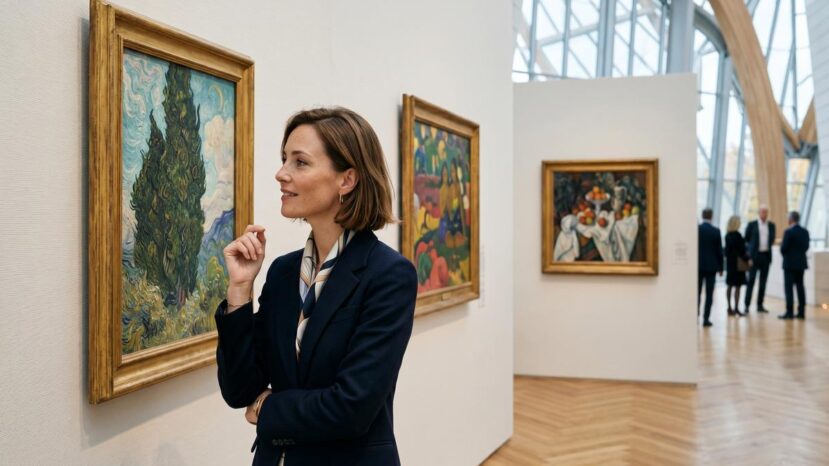
- Van Gogh’s *Cypress and Flowering Tree* (1889) has not been exhibited in France since 1908
- Van Gogh’s*Self-Portrait with a Bandaged Ear* has not been exhibited in France since 1937
- Fayet acquired Fontfroide Abbey in 1908, financing the purchase with the proceeds from the sale of two Gauguin paintings in a single afternoon
- The exhibition runs from October 9, 2026, to March 8, 2027, at 8 Avenue du Mahatma Gandhi, Paris 75116
Unpublished works and never-before-seen archival material
“Everything is new in this exhibition,” says Sylvie Patry. For instance, some of the paintings have not been shown in France since the early 20th century. This is the case, for example, with Van Gogh’s Cypress and Tree in Bloom, painted in 1889 and absent from French galleries since 1908.
In addition, Van Gogh’s*Self-Portrait with Bandaged Ear* —acquired by Fayet on March 21, 1902, from Émile Schuffenecker—has not been exhibited in France since 1937. These two paintings remained in his possession throughout his life. The collection also includes 9 works by Henri Matisse, among the 257 loans gathered for the occasion.
In addition, Sylvie Patry notes that this exhibition is “the result of several years of research” using previously unpublished archival materials. The curators have thus reconstructed the life story of a man whom history had nearly erased.
Fontfroide, a lifelong project
While Fayet’s collection is impressive, his most ambitious project remains the renovation of Fontfroide Abbey in Narbonne, which he acquired in 1908. To finance the work, he sold part of his collection, including two Gauguins that were sold in the space of a single afternoon.
Fayet did not, however, abandon the artists. On the contrary, he involved them in the reinvention of the monastery to create a “total work of art.” Thus, he commissioned stained-glass windows from the artist Richard Burgsthal—works that would make the journey from Fontfroide to the Grand Gallery 10 at the Louis Vuitton Foundation.
Fayet the Artist: A Side Still Unknown to the Public
The exhibition goes beyond the collection. Galleries 9, 10, and 11 on the top floor of the Fondation Louis Vuitton are dedicated to his work as an artist. The son of a painter, Fayet spent his entire life searching for his identity as a creator, as associate curator Angeline Scherf explains.
After starting out as an amateur painter, he became a ceramist, then an interior designer, a carpet designer, and even the founder of a fashion house. He also collected first editions of *Vogue*. Most of these works have never been shown to the public, remaining within the family.
The exhibition design is by Robert Carsen, the exhibition’s artistic director, who promises a “beautiful explosion of color.” Indeed, the Fondation Louis Vuitton offers Fayet the visibility that his era denied him: that of a man who viewed art with as much intensity as he created it.