
Art Deco, a floating pool on the Seine and Eiffel Tower views: Paris pools hide a little-known heritage
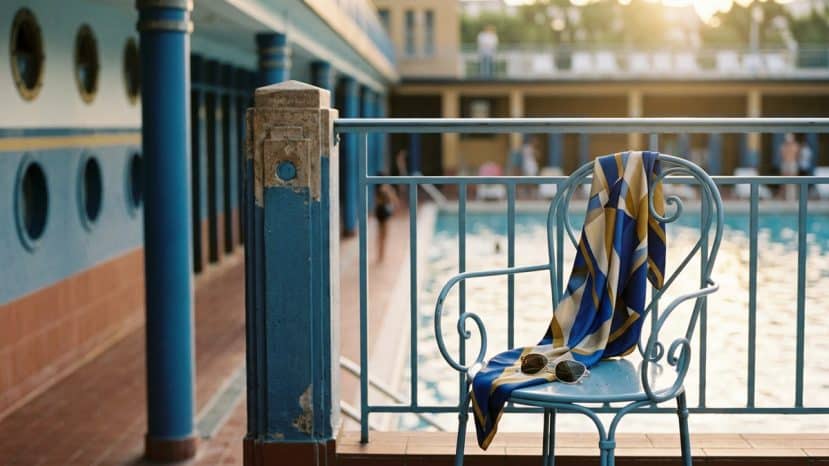


Paris pools are far more than simple swimming basins. They tell the story of the capital, from Art Nouveau to contemporary architecture, taking in listed monuments and breathtaking views over the Seine or the Eiffel Tower along the way. In 2026, this aquatic heritage remains alive, renovated and open to all.
From historic origins to today’s Paris pools
It was in fact the British and Germans who first embraced swimming as a sport. In France, the first swimming school was established on a floating basin on the Seine, founded by Barthélemy Turquin at the end of the 18th century. It would take until the late 19th century for the first indoor pools to appear.
The real turning point came in the 1920s, driven by the Paris Olympic Games of 1924. That momentum gave rise to several remarkable facilities, some of which are still in use today. This sporting and architectural legacy remains very much woven into the fabric of Paris.
La Butte-aux-Cailles, an Art Nouveau masterpiece
The Butte-aux-Cailles pool (13th arrondissement) has been a listed historic monument since 1990. Opened in 1924, it was designed by architect Louis Bonnier, a former Beaux-Arts student with a passion for Art Nouveau. He created a pool of flowing curves, playing with light through reinforced concrete and brick on the façade.
The architect conjured a kind of “cathedral” dedicated to sport, with its vault rising fifteen metres above the ground, paved with glass and hung with luminous fixtures. The pool has three basins: one indoors and two outdoors, along with a solarium.
“The architect created a kind of cathedral dedicated to sport, with its vault rising fifteen metres above the ground, paved with glass.”
Pailleron and Pontoise, a dive into Art Deco
The pool at the Pailleron sports complex (19th arrondissement) has been a listed historic monument since 1998. Built in 1933 by architect Lucien Pollet, who also designed the Pontoise and Molitor pools, it was completely renovated in 2006 with a new metal framework and a curved glass roof. The sports complex also includes an ice rink, rebuilt in 2006.
Constructed in 1934 by the same Lucien Pollet, the Pontoise pool reopened in December 2023 after two years of works. A testament to interwar architecture, it has been listed on the Supplementary Inventory of Historic Monuments since 1998. Notably, in 1936, Commander Cousteau conducted his first scuba diving experiments here.
- Butte-aux-Cailles (13th arrondissement): listed historic monument since 1990, opened in 1924
- Pailleron (19th arrondissement): listed historic monument in 1998, renovated in 2006
- Pontoise: listed on the ISMH in 1998, reopened in December 2023
- Joséphine Baker: Paris’s only floating pool, open since July 2006
- Château-Landon (10th arrondissement): Paris’s first covered, heated public pool, inaugurated in 1884
The Joséphine Baker pool offers a truly unique experience among Paris pools. Moored at the port de la Gare, at the foot of the Bibliothèque François-Mitterrand, this glass-and-steel structure designed by architect Robert de Busni is kept afloat by twenty metal buoys. Open since July 2006, it is the distant heir to the Deligny pool, a floating pool that sank on 8 July 1993.
Château-Landon, the grande dame reborn
Inaugurated in 1884, the Château-Landon pool (10th arrondissement) is Paris’s first covered, heated public pool. Designed by architect Lucien-Dieudonné Bessières on commission from the Société française de gymnastique nautique, it embodies a rare heritage. Fully renovated, it reopened on 23 February 2026.
The pool’s historic character has been preserved while its facilities were brought up to date. Water treatment has been optimised, the lighting redesigned, and the floors and showers completely refitted.
Singular pools for extraordinary experiences
The Amiraux pool (18th arrondissement) served as the backdrop for a scene in Jean-Pierre Jeunet’s Amélie. This architectural gem was built by Henri Sauvage in 1927, then beautifully restored between 2015 and 2017. Henri Sauvage also designed floors 2 and 3 of La Samaritaine department store.
In the 15th arrondissement, the Emile-Anthoine pool offers a breathtaking view of the Eiffel Tower directly from its municipal basin. In summer, a solarium lets swimmers soak up this panorama after their lengths. Few Paris pools can claim such a spectacular setting.
The Thérèse et Jeanne Brulé pool (14th arrondissement) welcomed its first swimmers in February 2020. It stands out for its two basins and an array of energy-saving features: an air handling unit with a heat pump, solar thermal collectors and heat recovery from wastewater. Meanwhile, the Marie-Marvingt pool, on the rue du Renard (Paris Centre), renovated in 2019, boasts a resolutely contemporary 25-metre stainless steel basin.
Georges-Vallerey, the Olympic pool of the 20th
The Georges-Vallerey pool (20th arrondissement), built for the 1924 Summer Olympic Games, was originally known as the Piscine des Tourelles. It was here that swimmer Johnny Weissmuller won 4 medals, including 3 gold, at the 1924 Games. Its 50-metre basin still delights Paris swimmers to this day.
As soon as the warmer months arrive, the retractable roof allows swimming in the open air. Between 1986 and 1989, a renovation equipped the building with an enormous sliding roof. The complex includes a 50 m x 21 m Olympic pool, divisible by a movable partition, and seating for 1,500 spectators. Among all Paris pools, it is one of the few that hosts swimming and water polo competitions at this level.