These four philosophers reopen the Agora to teach us how to live better
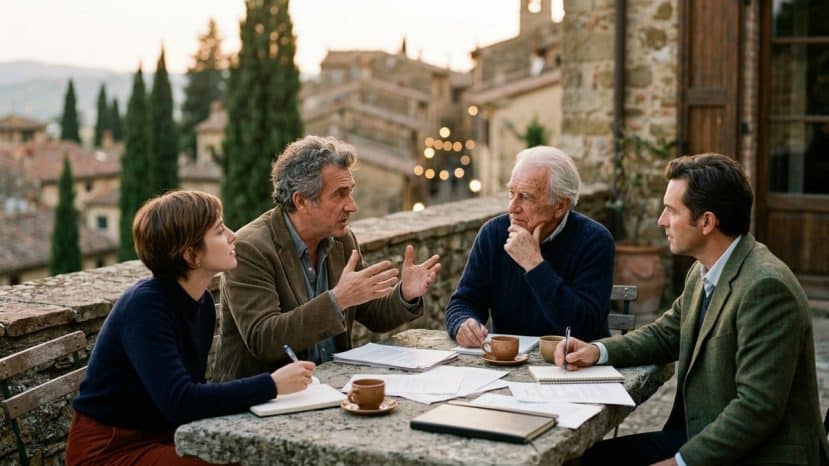


What if philosophy were, above all, an art of living better? That is the conviction shared by Sophie Galabru, Julia de Funès, Marianne Chaillan and Charles Pépin, four voices breathing new life into a millennia-old discipline to answer the most intimate questions of our time. In 2026, their books are flying off the shelves, proving that thinking can also be a way of staying on your feet.
Philosophy, a wisdom for living better every day
To philosophise is not merely to learn how to die, as a long tradition stretching back to Montaigne would have it. It is also, and perhaps above all, to learn how to live, as the ancient wisdom of Epicureanism, Stoicism and Platonism already proposed. Building one’s “inner citadel“, to borrow the phrase of historian and philosopher Pierre Hadot, means living in harmony with oneself, standing firm in one’s convictions and free in one’s mind.
Sophie Galabru, a philosophy agrégée, puts it plainly: “I have never understood the charge of abstraction levelled at philosophy, when it is in fact concerned with every subject that runs through our lives.” Indeed, philosophy lends both rigour and poetry to questions we have been asking since childhood, sometimes in secret.
These four authors have gone in search of answers from Plato, Socrates, Descartes, Spinoza, Kant and Nietzsche, among others, on the subjects of love, death, identity, failure, desire and happiness. Their books are not quick-fix manuals for lifting your spirits. They are possible pathways for understanding the world, other people and ourselves.
“Unlike self-help, philosophy makes no claim to spare us from suffering, on the contrary, it holds that suffering is necessary. Nor does it ever tell us what to do or hand out advice and instructions.”, Marianne Chaillan
Philosophy versus self-help: a clear dividing line
Julia de Funès draws a precise boundary between the two approaches. “Philosophy has an enormous body of work that demands long, slow time; self-help promotes quick time,” she explains. One seeks a better version of the self; the other does not flatter the ego. It is, she says, “a permanent state of doubt”.
Where self-help promises recipes, philosophy asks questions. It offers no cheap reassurance. What it does offer, however, is a depth that express methods can never reach.
To live better, then, is not a matter of following instructions. It is a matter of questioning, doubting, thinking for yourself. That is precisely what these four philosophers invite their readers to do.
- Is love stronger than death?
- How do we defy nostalgia and survive loss?
- Why do we keep making the same mistakes?
- Who am I really, and how do I fully live out what I desire?
- What virtues lie hidden in our failures?
Charles Pépin and the art of asking the right questions
Charles Pépin confirms that the art of philosophy lies in the way we interrogate. “To help people and answer their questions, an approach that crosses psychoanalysis, neuroscience and philosophy is a fascinating one,” he argues. Every month for thirteen years, he has run a seminar open to all in the main hall of mk2 Odéon.
Every week on his podcast, he also attempts to answer the great questions that animate or unsettle us. In his view, what does us good is not so much the answers as the questions asked together, because they make us feel less alone in our contemporary bewilderment.
His book Où trouver la force ? Et autres questions existentielles brings together fifty-eight questions with genuine answers. Can we, as adults, heal the wounds of childhood? How do we know whether our work truly suits us? Why do we need to be loved? These are questions that cut to the heart of what it means to live better.
Charles Pépin also reminds us that ancient philosophy already offered something more existential than speculative. In that sense, it did not wait for our era to take an interest in the concrete lives of women and men.
Books that speak to the anxieties of our time
Never before have philosophy books addressing our everyday questions sold so well. A need to illuminate our lives differently? To ward off the chaos of the age? To fill the spiritual void left by the collapse of the great ideologies of the twentieth century? Philosophy steps up to the challenge.
“At a particularly anxious time, thinking through what is happening is the philosopher’s role,” says Charles Pépin. Philosophy shows women and men that they are not alone. Other philosophers have grappled with these questions and offered answers to be lived, not merely to be thought.
Marianne Chaillan, for her part, insists that “there is a necessity to come back down to the public square and the Agora, which was, after all, where philosophy began”. To live better, then, also means engaging in free, deliberative public speech in a world where landmarks are fading.
Four books for navigating life’s great ordeals
Sophie Galabru, in Nos dernières fois, Défier la nostalgie, turns her attention to the last glance, the last caress, the last words. How do we face these moments with something other than dread or sorrow? Her book offers ways to live better through the very instants we fear most.
Julia de Funès, in Pensées distinguées, takes on an era saturated with binary discourse and fake news. How do we learn to think for ourselves? How do we distinguish evidence from truth, offence from harm, consent from resignation? These questions are, consequently, at the heart of a healthy intellectual life.
Marianne Chaillan, in Survivre, confronts the question of loss. Since nothing lasts and everything slips away, our youth, our hopes, the people we love, how do we accept the cruel rules of the game of loss? Her book is an invitation to hold on, to resist, to live better in spite of everything.
Philosophy, that “essential old lady who endures”, as Julia de Funès puts it, needed new translators. Dense, difficult to access, written in language that can verge on the impenetrable, it could no longer speak alone. These four authors have risen to that challenge. Their books of wisdom can, in fact, save our lives from boredom, from dread, from unhappiness, and even from ourselves. That, too, is what it means to live better.