
A fitness coach reveals how long you should hold a plank based on your age
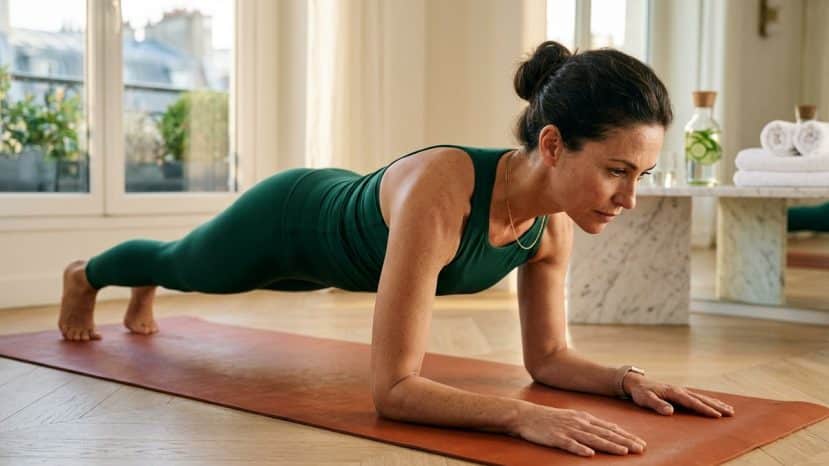


Holding the position a few seconds longer than the week before: it’s a simple goal that can completely transform your relationship with exercise. The plank is one of the rare moves capable of deeply engaging the core muscles without any equipment, but knowing what to aim for based on your age and fitness level makes all the difference.
What age really changes about your performance
The body evolves over time, and that shows up directly in your ability to sustain a static effort. The gradual loss of muscle mass, declining strength, and changes in joint function are all natural processes that affect how long you can hold the position. Yet according to Evan Williams, a fitness coach quoted in an article published on Health on 17 September 2026, regular training can significantly slow, or even offset, these declines.
There is no single universal number that applies to everyone. What does exist, however, are reference ranges that allow you to honestly assess where you stand and progress with concrete benchmarks. These ranges vary according to two criteria: age and overall fitness level.
Reference hold times by age group
For people aged 18 to 39, Williams suggests that 45 to 90 seconds is the range for the general population. Those in better physical shape can aim for 60 to 120 seconds. These figures reflect muscle capacity still near its peak, provided you train consistently.
- 18,39 (general population): 45 to 90 seconds
- 18,39 (good fitness level): 60 to 120 seconds
- 40,59 (general population): 30 to 75 seconds
- 40,59 (good fitness level): 45 to 90 seconds
- 60 and over (general population): 20 to 60 seconds
- 60 and over (good fitness level): 30 to 75 seconds
Between 40 and 59, the range drops to 30 to 75 seconds for the general population, and 45 to 90 seconds for more active individuals. From 60 onwards, holding for 20 to 60 seconds remains a perfectly valid target, while those in good shape can reach 30 to 75 seconds.
These benchmarks are not judgements, they are tools. They help you understand where you are and set realistic goals, without measuring yourself against standards that simply don’t apply to your age group.
Form comes before the stopwatch
Before chasing a personal best, make sure your technique is solid. Poor plank form not only reduces the benefits of the exercise, it can also cause lower back pain.
It all starts with alignment: elbows directly beneath the shoulders, spine in a neutral position. From there, actively engage the glutes, quads, and abs while drawing the ribs down and pressing into the floor to maintain stability. This is not a passive position: every muscle should be working continuously.
The most common mistake is letting the core go slack mid-hold. That release causes the lower back to arch and the spine to fall out of alignment. Williams is clear on this point: the goal is not to hold on at any cost, but to maintain full-body tension throughout the entire movement.
Variations to help you progress at your own pace
If the full position is still a challenge, there are accessible modifications. Dropping to your knees reduces the load on the core and lets you work on technique without risking injury. Similarly, elevating your hands on a stable step lowers the intensity and makes it easier to maintain good posture.
These variations are not just for beginners. They are also a useful tool for anyone returning to exercise after a break, or looking to build a solid foundation before increasing hold time. Because that is really the point: quality of movement should always come before quantity of time spent in position.