Louis Vuitton, Dior, Armani: the men’s bags that will dominate 2027


Carrying a designer bag today sends as powerful a signal as pulling up in a Lamborghini Urus, as the world’s biggest football stars proved at the World Cup, sporting luxury pieces with effortless confidence. Louis Vuitton, Dior, Armani and a host of other European houses have taken note, and the spring/summer 2027 menswear shows confirmed it in spectacular fashion. Men’s bags are no longer mere functional accessories: they now define entire collections.
From status symbol to everyday staple: why the men’s bag is having its moment in 2026
Europe’s major luxury houses have made a clear strategic choice. Men’s bags are priced below ready-to-wear, yet deliver the same prestige, the same artisanal excellence and the same power of self-expression. For the luxury consumer, they represent an accessible entry point into the world of the great fashion houses, without any compromise on status.
This dynamic was particularly visible at the Paris and Milan presentations for the SS27 season. Designers deployed a remarkable variety of silhouettes: totes, shoulder bags, document cases, pouches. Every category was rethought to suit contemporary lifestyles, going far beyond simple utility.
Soft materials and unstructured shapes: the confident comfort trend
One of the strongest directions of the SS27 season is the move toward soft, unstructured silhouettes. Giorgio Armani, under the creative direction of Leo Dell’Orco, presented an oversized duffle bag in ultra-soft taupe nappa leather, featuring two utilitarian bellows pockets at the front and a wide adjustable shoulder strap. The shape slumps naturally, with not a hint of rigidity.
Mihara Yasuhiro pushed this logic even further with a pale grey nappa leather model that folds into organic pleats. Taakk, designed by Takuya Morikawa, went for an oversized hobo in mustard yellow leather, with visible panel stitching and the brand’s logo in black. All three share the same philosophy: the bag moulds to the body rather than imposing itself upon it.
In the same relaxed spirit, drawstring closures made a notable comeback. Ami, by Alexandre Mattiussi, presented a smooth taupe leather pouch cinched with a fine leather cord. Setchu, designed by Satoshi Kuwata, combined a drawstring-gathered top with angular geometric panels fastened by metal snap buttons, creating a striking contrast between softness and structure.
Louis Vuitton and the drawstring pouch: when luxury reinvents the form
Louis Vuitton SS27, under the direction of Pharrell Williams, delivered one of the most talked-about pieces of the season. The house created a spiral matte leather bag in a snakeskin pattern, its shape evoking a conch shell. Inside, a classic monogram-printed drawstring pouch. A slim removable monogram canvas shoulder strap and gold-tone hardware complete the look.
This piece perfectly encapsulates Louis Vuitton‘s approach: reinterpreting a casual closure, the drawstring, through noble materials and sculptural construction. The result lends this style a luxurious appeal that other houses have equally sought to achieve, each through their own distinct codes.
- Louis Vuitton: spiral matte leather pouch, snakeskin pattern, interior monogram drawstring pouch
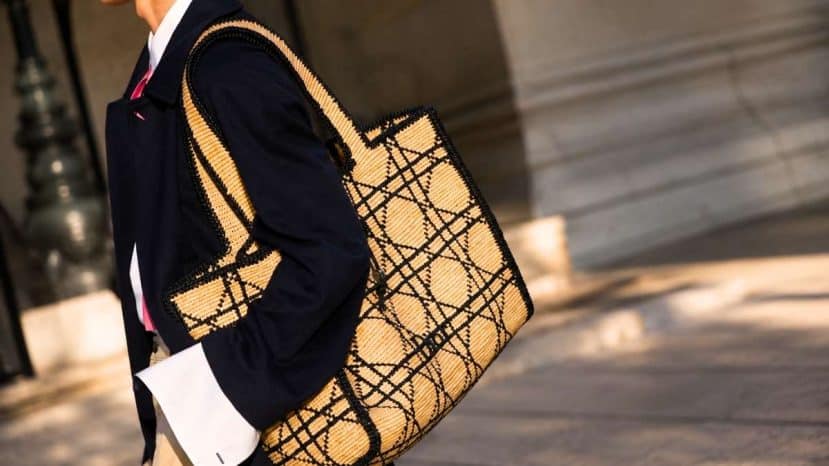
- Dior Homme by Jonathan Anderson: oversized woven tote with black macrocannage pattern and integrated logo
- Giorgio Armani by Leo Dell’Orco: taupe nappa duffle and hand-woven tote with matching miniature charm
- Ralph Lauren: natural raffia tote with leather trim and thick grained leather pouch
- Taakk by Takuya Morikawa: anthracite nylon tote inspired by furoshiki, shifting from a flat circle to a sculptural 3D crescent
The document case and the oversized clutch: two classics reinvented
The document case has long been confined to professional wardrobes. For SS27, designers set it free. Hed Mayner offered a tan leather model with layered modular elements, including a dark brown suede pouch and a wrist strap. Thom Browne opted for smooth tan full-grain leather with a brass push-lock clasp. Junya Watanabe, by contrast, chose premium smooth black leather with robust metal hardware.
Oversized flap clutches also confirmed their central place in the season. Maison Kitsune, under the direction of Abigail Smiley-Smith, presented a hand-woven pouch in natural paper raffia with an open-weave crochet structure. Dries Van Noten, by Julian Klausner, designed a caramel leather clutch intended to be scrunched, with a thick wrist strap sewn directly into the body. These choices reflect a growing confidence among men in carrying forms traditionally associated with womenswear.
Raffia, weaving and artisanal influences: the tote reasserts its supremacy
The XXL tote remains the centrepiece of the men’s wardrobe this season. Dolce & Gabbana paired a washed dusty-pink textured canvas with crocodile-effect burgundy leather trim. Ralph Lauren leaned into natural raffia straw with dark brown leather straps and stylised leather anchor details. Dior Homme, by Jonathan Anderson, wove the black macrocannage pattern into an oversized tote in natural tones.
Ziggy Chen brought a rawer edge with vertical panels of textured leather and suede in earthy tones, raw edges, bronze chain links and heavy metal eyelets. Taakk, meanwhile, surprised with a high-density anthracite nylon tote inspired by furoshiki, the traditional Japanese wrapping cloth: laid flat, it forms a circle; lifted, it takes on a sculptural crescent silhouette. These proposals confirm that the men’s tote of 2027 is as much an aesthetic statement as an everyday tool, and that Louis Vuitton is far from alone in rewriting the codes of luxury men’s bags.