Champagne Tsarine turns 30 with a zero-dosage cuvée limited to 1,800 bottles
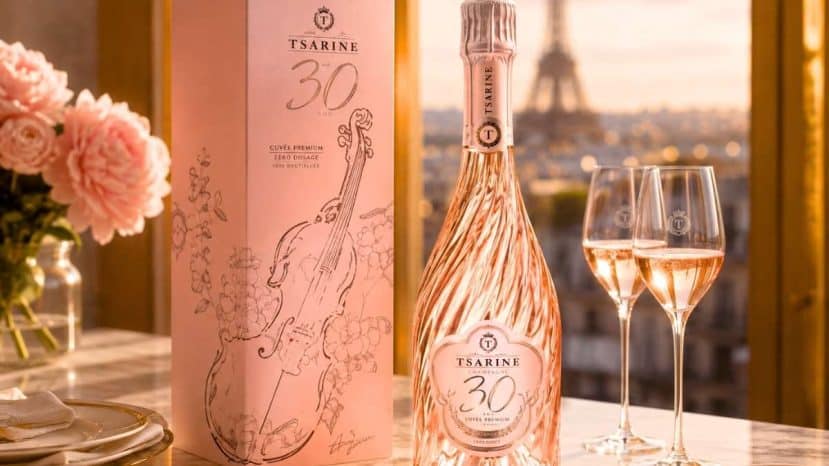


What happens when a Champagne house decides, for its thirtieth anniversary, to strip away the last layer of protection standing between the wine and the taster’s eye? Champagne Tsarine answers that question with an anniversary cuvée in zero dosage, produced in a run of just 1,800 bottles, 250 magnums and 500 jeroboams. It is a choice that commits as much as it reveals.
A blend built on tension rather than opulence
The cuvée rests on a precise architecture: 50% Chardonnay, 35% Pinot Noir and 15% Meunier. What strikes you immediately is the role given to Chardonnay as the backbone of the blend. The Montagne de Reims is historically associated with Pinot Noir, yet Tsarine inverts the expected logic here, pursuing verticality over roundness.
The grapes come exclusively from Grands Crus and Premiers Crus spread across six villages: Tours-sur-Marne, Bisseuil, Ludes, Sermiers, Trépail and Villers-Allerand. This geographic focus on the Montagne de Reims is deliberate. It reflects a desire for coherence between the terroir selected and the profile sought in the glass.
On the palate, the cuvée unfolds notes of citrus, peony and restrained red fruit, before a saline finish. The reading is more vertical than demonstrative, exactly what zero dosage delivers when the raw material is up to the task.
What zero dosage actually changes for the wine
Zero dosage eliminates the addition of liqueur de dosage after disgorgement. This sugar-based adjustment, present in the vast majority of Champagnes, normally rounds off the edges and balances acidity. Without it, every imperfection in the blend becomes visible. It is an unforgiving exercise.
For this approach to work, time plays a decisive role. The 2021 harvest benefits from full malolactic fermentation, followed by four years of ageing in the cellar and a minimum of six months after disgorgement. This extended time on the lees provides the texture needed to compensate for the absence of dosage. Isabelle Tellier, the house’s cellar master for twenty-five years, sums up the choice this way: zero dosage allows the wine to express itself in its purest form, without any artifice.
This style has gradually established itself in contemporary gastronomy, among audiences accustomed to drier profiles. But it remains demanding to produce: the precise balances require time, limited volumes and strict cru selection. The rarity of this edition is therefore not a communications exercise, it follows directly from these technical constraints.
Thirty years of Champagne Tsarine and an identity built in the details
Founded in 1996 by Philippe Baijot and today led by Enguerrand Baijot, the house built its identity around a bottle with twisted lines inspired by a decanting carafe. In a region where the bottle has often remained a territory of aesthetic conservatism, this choice of silhouette functioned early on as a language in its own right.
At thirty, Tsarine adds a further dimension to this cuvée through a collaboration with violinist Esther Abrami, the house’s ambassador and herself born in 1996. She has composed an original melody inspired by the cuvée and conceived the case, illustrated with a violin threaded through musical notes. The addition could have remained purely decorative. It works because it stays secondary: the wine holds the first place.
- Blend: 50% Chardonnay, 35% Pinot Noir, 15% Meunier
- Terroir: Grands Crus and Premiers Crus from the Montagne de Reims exclusively
- Ageing: 4 years in the cellar, then a minimum of 6 months after disgorgement
- Dosage: zero dosage, full malolactic fermentation
- Production: 1,800 bottles, 250 magnums, 500 jeroboams
A clarification more than a celebration
In a market where many historic houses seek reassurance through heritage or visual hyper-luxury, Champagne Tsarine chooses a different direction: a barer reading of the wine, without a safety net, without last-minute adjustment. At thirty, this is less a party than a statement of intent.
This approach connects to a broader trend in contemporary Champagne: the most interesting cuvées are often those that accept a degree of technical rarity rather than mass distribution, not to manufacture artificial desire, but because precision has a cost in time and volume. The anniversary cuvée from Tsarine is a direct and coherent illustration of exactly that.