At Hermès, they drop €100,000 in two minutes on a crocodile giraffe
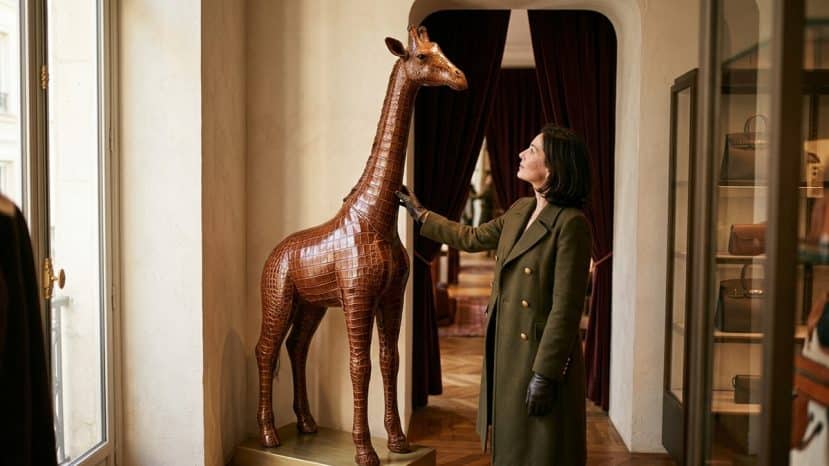


A two-metre crocodile giraffe, bought in under two minutes for €100,000: this is the kind of transaction that illustrates, better than any sales figure, what it truly means to spend without limits at Hermès. Pascale, a sales adviser turned after-sales specialist at a Parisian boutique for the house, spent years watching these extraordinary buying behaviours up close.
When €100,000 is “peanuts” at Hermès
Christmas 2001. The house was running a one-of-a-kind creation workshop called “petit H”. Among the pieces on display: a two-metre-tall crocodile giraffe. A couple walked in that day intending to buy a bag. No model was available. Pascale, half-joking, steered their attention toward the giraffe. The couple’s children were instantly smitten. In under two minutes, the sale was done for €100,000. For this family, Pascale notes, that sum meant nothing in particular.
This kind of six-figure impulse buy is not an anomaly in this world. It reveals a clear divide between two types of clients. On one side, the “ordinarily wealthy” customer, someone who earns well, treats themselves occasionally to a scarf or a jumper, and builds up their porcelain service piece by piece. On the other, the “ultra-rich” client, who walks in and spends without ever glancing at a price tag.
The ultra-wealthy want what no one else can have
The distinction between the rich and the ultra-rich goes beyond budget. It also comes down to the type of pieces they covet. Wealthy clients look for objects that read as social markers. At one point, that meant a taupe Birkin in size 40. The ultra-rich, on the other hand, are after absolute exclusivity, limited editions, whatever the price.
One client, a devotee of the house’s iconic sandals, owns them in every colour. At nearly €800 a pair, that alone is a significant investment. But more to the point, he was the first to get his hands on a pair in Himalayan crocodile skin, now valued at over €7,000. It is that primacy, owning what no one else has yet, that truly drives these purchases.
Eye-watering prices, from key ring to throw
To understand the price scale at this house, a few reference points help. A key ring or “gris-gris” charm can run to €2,700, close to two French minimum monthly wages. A belt with the iconic H buckle sits at around €1,000. A throw can climb to €5,500. And Kelly bags, depending on the material and finish, trade anywhere between €25,000 and €150,000.
- Key ring or “gris-gris” charm: around €2,700
- Belt with H buckle: around €1,000
- Throw: up to €5,500
- Iconic sandals: nearly €800 a pair
- Himalayan crocodile sandals: over €7,000
- Kelly bag: between €25,000 and €150,000
These prices are partly explained by the craftsmanship involved. Crocodile bags are made entirely by hand. First, the skin must be sourced; then comes a considerable amount of production time. As a result, these pieces are harder to acquire and require a long-standing relationship of trust with an adviser.
The client-adviser relationship: the key to rare pieces
What many people don’t realise is that access to the most coveted models is built over months, sometimes years. The house reserves certain pieces for its most loyal clients, those who spend regularly and whose adviser knows they won’t flip the item on the grey market. That is how access to crocodile bags and limited editions actually works.
This closeness can lead to unexpected situations. Pascale once received a watch worth €35,000 from a grateful client, a gift she was, of course, not permitted to keep. Meanwhile, less patient clients, often among the “ordinarily wealthy”, struggle badly with waiting. A 19-year-old woman, for instance, walked in demanding an immediately available Kelly bag. When told the model was not in stock, she burst into tears, insisting she could not go on holiday with her friends without it.
In after-sales, bad faith has its greatest hits too
Now working in after-sales, Pascale encounters another side of this clientele. A man had purchased a pair of leather sandals. The care instructions are clear: do not wear them to the beach, as water, salt, sun and sand rapidly degrade the leather. A month after buying them, he brought the pair back in a severely deteriorated state, with sand still visibly embedded in the split leather. When this was pointed out to him, he replied that he didn’t see the issue, it was private beach sand, after all. That anecdote alone sums up a certain vision of luxury: one where the product must adapt to the client, never the other way around.