
Mellerio is putting diamonds on your nails, a patented idea that dates back to 1951
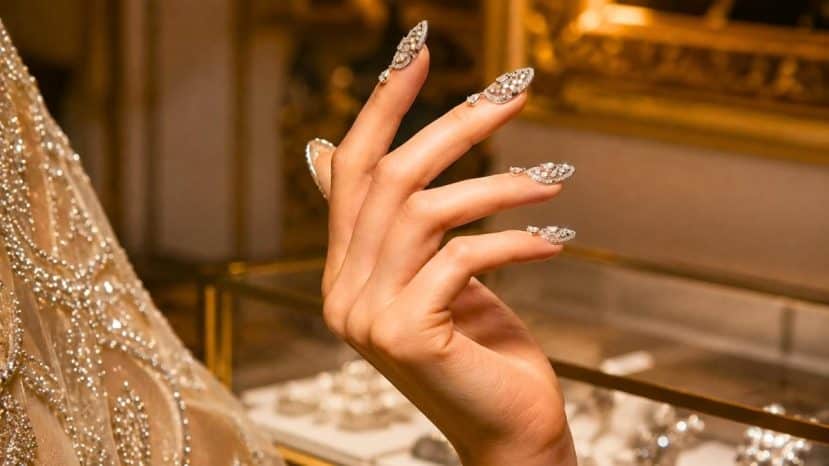


What if your nails became the next setting for diamonds? That is exactly what Mellerio is proposing in 2026, with a collection of fine jewellery designed to sit directly on top of a manicure. Behind an idea that seems to come out of nowhere lies a history stretching back more than 70 years.
A 1950s patent brought back to life by Mellerio
It all started in the Maison’s archives. While exploring them, Laure-Isabelle Mellerio, artistic director and representative of the 14th generation of the family, came across a patent filed in 1951 along with several metal prototypes, pieces she describes as remarkably daring for their time.
The idea of reviving these ornaments had been on her mind for years. Yet a technical obstacle stood in the way: how do you attach a precious jewel to a nail without making it uncomfortable, and without forcing the wearer to visit a nail technician just to remove it? The original system, based on a small rubber band encircling the nail, simply did not meet those requirements.
The solution came from an unexpected source. After consulting engineers and orthodontists, it was ultimately Laure-Isabelle Mellerio’s own nail technician who suggested using the adhesives designed for false eyelashes. The principle is now straightforward: an adhesive sized to fit the nail, then the jewel placed on top. For longer wear, a touch of nail glue can reinforce the hold.
How to build your own jewellery manicure
The collection comes in three distinct versions, each conceived for a very different aesthetic. The first, in white gold and diamonds, stays true to the spirit of the original archival design. The second leans into a rock sensibility with black diamonds. The third, in yellow gold with precious stones and multicoloured fine stones, more closely reflects the Maison’s identity, one of whose signatures is precisely colour.
- White gold and diamonds, in keeping with the model patented in 1951
- Black diamonds for a more rock and contemporary edge
- Multicoloured yellow gold with precious stones and fine stones
- Available in several sizes for each version
- Can be worn alone or combined across multiple nails
Each piece comes in different sizes, making it possible to wear them individually or mix and match freely. The central idea is not to replicate a classic manicure, but to let each client compose her own jewelled hand: one nail here, another there, blending colours and styles. Laure-Isabelle Mellerio likens this spirit to that of the Cabinet de curiosités line, where each person assembles their own jewel from a chain and a selection of charms.
Heritage as a starting point, not a constraint
Behind this collection lies a broader reflection on how a house founded several centuries ago can remain fully rooted in the present. For the artistic director, heritage is not a straitjacket. On the contrary, it is a raw material to be transformed, preserving the Maison’s DNA while staying attuned to everything happening around it.
Colour, the oval form, and certain long-forgotten techniques thus become springboards for new creations. Mellerio is also the oldest independent jewellery house in the world, and that historical weight feeds innovation directly rather than holding it back.
The artistic director also outlines specific geographical ambitions for the road ahead: breaking into two new markets, the United States and the Middle East. This nail jewellery collection is therefore part of a wider drive toward international reach.
After nails, what new territories await fine jewellery?
The question arises naturally: if nails had to wait more than seventy years to find their moment, which other parts of the body might be revisited next? Laure-Isabelle Mellerio does not rule out further explorations. She mentions the ears as a territory already extensively explored, and speaks more broadly of the head as a creative space that remains wide open.
For now, she continues to dig through the Maison’s archives, with the sense that an unexpected find could one day give rise to an entirely new jewellery category, even if not every discovery is necessarily destined to reach the market. This, she says, is one of the most stimulating dimensions of working with memory.
For the moment, Mellerio is focused on this new category which, more than seven decades after its invention, seems at last to have found its era and its audience.