
Work the brush through thin sections”: the hairdresser’s method for a salon-worthy blowout at home
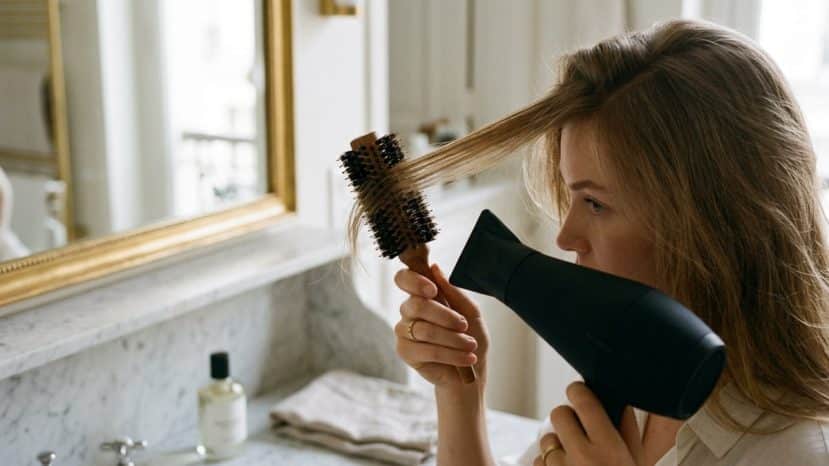


Have you ever spent twenty minutes pulling at your hair with a round brush, only to end up with one side voluminous and the other completely flat? That disappointing result rarely comes down to your hair itself, it almost always comes down to the wrong technique. A few hairdresser’s pointers are all it takes to turn a home blowout into something that genuinely rivals the salon.
The tools that make all the difference
Before you even pick up a brush, your choice of tools will determine the final result. A hairdryer with a concentrator nozzle is the centrepiece of the whole setup, because it channels the airflow in one precise direction rather than scattering it. That detail changes everything: air directed from roots to ends smooths the cuticles instead of ruffling them.
The diameter of your round brush then dictates the finish. A small-diameter brush is ideal for creating tight curls or lifting a fringe, while a large diameter delivers a soft, smooth result with volume on medium to long hair. Beyond that, a few clips to section the hair, a comb to draw clean partings, and a paddle brush for the finishing touch are all you really need.
On the product side, a smoothing shampoo and conditioner duo preps the hair right from the shower. Follow up with an anti-frizz treatment or smoothing oil on the lengths, then a heat-protectant spray before you start drying.
The step-by-step technique for a blowout that lasts
Pre-drying is a step many people wrongly skip. The idea is to dry your hair with the hairdryer until it is about 80% dry before picking up the brush. That level of residual moisture keeps the section manageable, not too heavy, not too dry.
Start at the nape of the neck, with the rest of the hair clipped up. The golden rule is to work with thin sections of around 2 to 3 cm: a section that is too thick simply won’t sit properly on the brush. Place the brush at the root, lift to create volume at the base, then glide down to the ends while keeping the section taut. Hold the hairdryer 10 to 15 cm away from the section, nozzle pointing downward.
At the ends, a quarter-turn of the brush inward creates a classic rounded finish. Roll the section further and you get a wavy effect. Finish each section with a blast of cool air to set the shape. Repeat this process zone by zone, working up to the top of the head.
Adapting the method to your hair type
Your hair type calls for a few practical adjustments. Here are the key points to keep in mind depending on your hair texture:
- Fine hair: opt for medium heat and a large brush to build volume without weakening the hair fibre.
- Thick hair: work with even smaller sections and allow more drying time, without holding the hairdryer too close.
- Naturally wavy or curly hair: the result won’t hold quite as long as on straight hair.
- Naturally straight hair: a well-executed blowout generally lasts two to three days.
These adjustments don’t change the core method, but they help you avoid the two most common mistakes: scorching fine hair with too much heat, or leaving thick hair insufficiently dry, which causes the volume to collapse within hours.
Why the blowout is making a major comeback in 2026
From red carpets to social media, ultra-glossy lengths and controlled volume are everywhere this year. This renewed enthusiasm for the sleek, voluminous look explains why so many people are trying to recreate it at home. Because the blowout remains one of the hardest styles to nail without clear guidance, between frizz, poorly chosen tools, and sections that are too thick, the pitfalls are plentiful. Mastering the hairdresser’s method means achieving a professional finish without ever leaving the house.