This season, eyebrows are doing their own thing, and that’s exactly the point
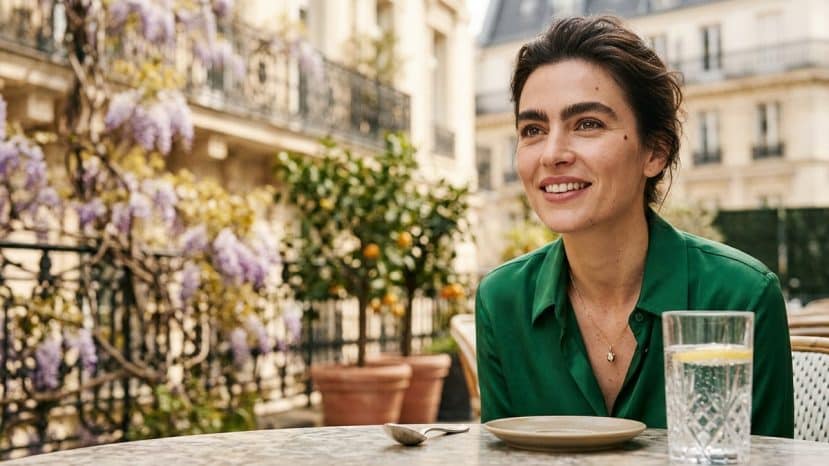


Brushing, tinting, letting them grow back, or simply stepping away from the tweezers: the way we care for our eyebrows has changed profoundly. Gone are the days when a single celebrity could dictate one shape for everyone. In 2026, every face calls for its own answer.
From trend-driven to tailor-made eyebrows
For decades, eyebrows functioned as a marker of the times. The 1990s and 2000s imposed ultra-thin arches, almost thread-like. The 2010s swung toward bold, graphic thickness, driven in large part by model Cara Delevingne. Every era had its template, and women fell in line.
That relationship with trends has fundamentally shifted. Social media has certainly pushed radical statements, ultra-thin brows, bleached brows, into the spotlight. Yet these looks remain editorial trends, visible on runways and in magazines, without ever truly taking hold in everyday life. Lucia Popa, brow expert and founder of the house bearing her name, confirms it: some young women visually slim their arch by applying concealer, but they no longer risk removing the hairs themselves, wary of hardening certain expressions or creating an imbalance.
Anastasia Soare, founder of Anastasia Beverly Hills, also points out that bleaching, while more reversible than waxing, demands upkeep just as demanding as it is for hair colour, enough to cool the enthusiasm of even the most adventurous.
What professionals are seeing in their studios
The most striking shift shows up in what clients are actually asking for. Lucia Popa describes a clear evolution: a few years ago, women would walk in with a celebrity photo and want to replicate it at all costs. Today, they want to open up their gaze, look less tired, or simply find something natural that feels like them.
This shift rests on a firm conviction: the eyebrow is a defining feature. Two women can share the same face shape and have entirely different brows. Universal rules, then, cannot be applied mechanically. Lucia Popa insists that an eyebrow should never be considered in isolation from the face it belongs to. The overall reading, morphology, asymmetries, natural growth pattern, spontaneous movement, takes precedence over any pre-set formula.
Beyond aesthetics, altering the line too aggressively can throw off the balance of the face and change the way emotions register on it. One more reason to favour a personalised approach.
The right moves to reveal your natural eyebrows
In practice, this bespoke philosophy translates into precise, measured gestures. Tweezers remain an indispensable tool, but their role has evolved: the goal is no longer to create a new shape, but to reveal the one that already exists, removing only what disrupts the balance and strays from the natural line.
- Avoid scissors at home: trimming the hairs alters their natural fall and robs the brow of its fluid movement.
- Lean on tinting: it visually densifies by colouring the finest, lightest hairs.
- Apply a nourishing treatment regularly, a keratin serum or castor oil, to soften the hair, reduce breakage, and make styling easier.
- Brush brows upward before applying any makeup, as Anastasia Soare recommends.
- Use a pencil in light, feathery strokes to fill in sparse areas, concentrating product on the tail, which is naturally less dense, and keeping the front of the brow lighter.
Among the products mentioned, the Typology Lash and Brow Serum and The Ordinary Multi-Peptide Lash and Brow Serum are cited as examples of nourishing formulas suited to this approach.
Setting gel, yes. Lamination, less and less.
Setting gel has become an everyday essential: it tames movement without stiffening the hair, which is precisely the aesthetic people are after right now. Brow lamination, on the other hand, the technique that straightens and sets hairs upward, is losing its appeal. The return to natural works against it, since an overly disciplined brow sits uneasily with the current mood.
Anastasia Soare captures the spirit of the moment perfectly: we are no longer chasing perfect eyebrows, but living ones. That phrase says everything about a deeper shift, one in which texture, movement, and slight irregularities become qualities worth preserving, not flaws to correct.