
150,000 micro-needles in this Typology anti-ageing serum to test over 28 days
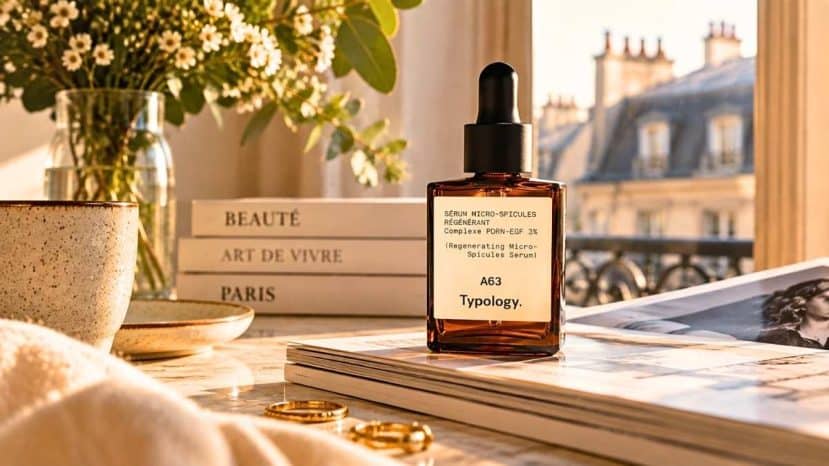


A light tingling on application, smoother skin after four weeks: the Typology anti-ageing serum A63 banks on technology from South Korea to promise visible results at home. Behind that claim lies a precise mechanism worth understanding before you commit.
PDRN, EGF and collagen: what the Typology anti-ageing serum is really targeting
The loss of skin firmness is no mystery. Juliette Lailler, co-founder of the brand Krème, reminds us in ELLE: collagen is produced by fibroblasts, the dermal cells responsible for tissue tone. From your thirties onwards, their activity slows, and the skin gradually begins to sag.
The classic problem with anti-ageing serums is the size of the active molecules. Juliette Lailler points out that collagen applied directly to the surface never reaches the deeper layers where it would actually be useful. It ends up acting as a simple humectant, with no real regenerating effect. That is precisely the barrier the Typology anti-ageing serum A63 sets out to bypass.
To do so, the formula combines two trending actives: PDRN and EGF, at a concentration of 3%. These molecules aim to restart the skin’s natural collagen production by stimulating fibroblasts, rather than simply depositing collagen on the surface. According to Vogue France, the PDRN used in this product is derived from biotechnology rather than salmon DNA, making it vegan.
How micro-spicules open the door for active ingredients
The real gamble of the Typology anti-ageing serum lies in its 150,000 spicules integrated into the formula. These natural micro-needles, often sourced from marine sponges, are invisible to the naked eye. They penetrate to the dermis and create tiny channels in the skin, triggering a repair response that firms the tissue.
This mechanism is inspired by the microneedling performed in professional clinics, but at a shallower depth. The risk of irritation is therefore lower than with an in-clinic session. The tingling felt on application signals that the product is working: it is the skin’s normal reaction to these micro-perforations.
Mélanie Klein, Typology’s product manager, explains the appeal of this combination: the micro-spicules allow the EGF and PDRN complex, molecules that are usually too large to cross the skin barrier, to penetrate deeper into the epidermis. This enhanced delivery aims to stimulate cell renewal and collagen synthesis, resulting in a smoother skin texture and a revived radiance over the course of the treatment.
What this anti-ageing treatment concretely promises in 28 days
The A63 Regenerating Micro-Spicule Serum makes a measurable claim: smoother, firmer skin in 28 days. This announced result rests on the synergy between the micro-channels created by the spicules and the enhanced penetration of the PDRN and EGF actives into the layers where collagen is actually produced.
This positioning places the Typology anti-ageing serum in a category of its own: neither a surface treatment nor a medical procedure, but an intermediate alternative inspired by professional techniques. The French brand Typology draws on this technology, popularised in South Korea, to offer a regenerating treatment you can use at home.
- 150,000 spicules per bottle to create micro-channels in the skin
- 3% PDRN-EGF complex to stimulate fibroblasts
- Biotechnology-derived PDRN, free from salmon DNA: vegan formula
- Results expected in 28 days on firmness and skin texture
- Shallower action than an in-clinic microneedling session, with a reduced risk of irritation
How to use the Typology A63 serum correctly
Typology recommends applying this treatment in the evening, one to two times per week. This frequency is intended for non-sensitive skin types. The tingling felt on application is normal and indicates that the product is active on the skin.
This weekly rather than daily cadence sets the Typology anti-ageing serum apart from conventional skincare. It reflects the nature of the micro-spicules: the skin needs time between applications to complete its repair response and fully benefit from the actives deposited in the deeper layers.