Expert hairdresser tips to look ten years younger with the right hair colour
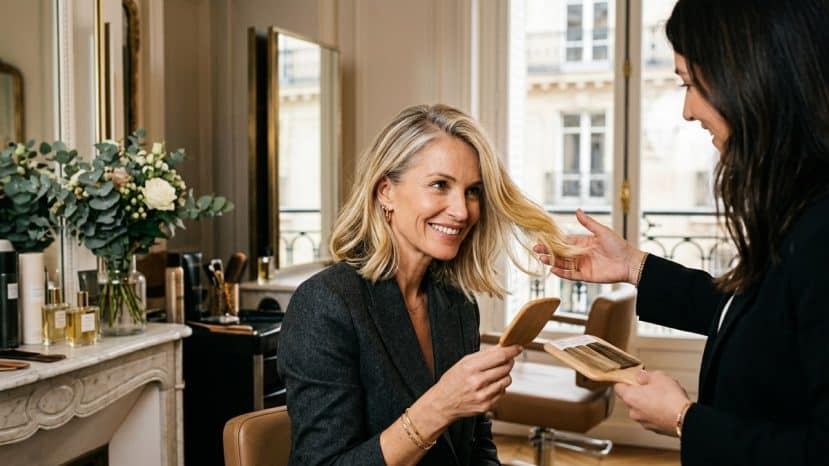


Changing your hair colour after 45 can feel like a risk, yet a few well-considered tweaks are sometimes all it takes to transform a face. The expert hairdresser tips gathered by Vogue UK all point to one central idea: it is not the colour itself that takes years off, but the light it brings to the face.
Why very dark colours can harden your features
Many women believe a dark head of hair projects character and presence. Yet after 45 or 50, a very uniform brown or black shade creates a strong contrast with the face. Far from being flattering, that contrast can sharpen features rather than soften them.
The colouring specialists quoted by Vogue UK point out that softer shades produce a more luminous, more natural effect. That does not mean abandoning dark tones altogether. A brunette can absolutely keep her base colour, provided she adds some dimension to it: a few warmer highlights, a slightly lighter frame around the face, or a less opaque shade can be enough to change the result entirely.
This is where professional colourist recommendations really come into their own. Two people with the same hair colour may need very different shades depending on their skin tone, eye colour, and natural base.
Warm shades that add radiance, according to hairdresser tips
If the urge to go lighter strikes, there is no need to chase a radical transformation. Warm, luminous tones are particularly well suited to creating that softening effect without sacrificing the natural depth of the hair. A brunette can be revived with caramel highlights. A chestnut shade gains radiance with a few touches of honey.
For blondes, creamy or golden shades are preferable to a very cool, uniform blonde. In every case, the goal remains the same: to bring light into the hair without erasing its depth.
Elena Ruiz, a New York-based colourist quoted by Vogue UK, stresses the importance of adding clarity around the face. Luminous touches create dimension, visually soften features, and give the complexion a greater glow. It is a technical detail, but its visual impact is real and immediate.
- Favour slightly lighter shades around the face
- Avoid very dark, uniform colour after 45
- Go for warm tones such as caramel, honey, or golden blonde
- Add dimension to a dark base with warmer highlights
- Tailor the shade to your skin tone, eyes, and natural colour
Staying close to your natural colour, a strategy that often pays off
Colourist Beth Minardi, interviewed by Vogue UK, advocates a gradual approach. Rather than trying to cover every grey hair with a heavily pigmented dye, she recommends letting the shade evolve gently. Staying close to your natural colour, or opting for something slightly lighter, is often a smart move as grey hair becomes more prominent.
A few lighter pieces can add dimension to the natural base and ease the transition as silver hairs appear. This approach also avoids the flat, uniform look that an all-over colour can sometimes produce, which may read as artificial. Professional colourists are united on this point: subtlety is more effective than a dramatic change.
Grey blending, an alternative for very white hair
For those who already have a significant proportion of white hair, hairdresser tips open up another avenue. Grey blending involves weaving white or silver hair together with pieces in various shades, rather than concealing it entirely.
The technique has several practical advantages. It eliminates the stark contrast between a white root and a dark colour. It also offers a more gradual transition and potentially requires less upkeep than a full-coverage colour. For anyone looking to simplify their routine while maintaining a polished result, it is an option well worth considering.
Ultimately, expert hairdresser tips all point in the same direction: the light brought to the face matters more than the colour chosen. Whether through warm highlights, brightening pieces, or a grey blending technique, it is the work on tone and dimension that makes the difference. The advice of these specialists invites us to think of colour not as a mask, but as a tool for revealing the face’s natural radiance.