It frames the face”: the fringe Parisian hairdressers recommend after 50
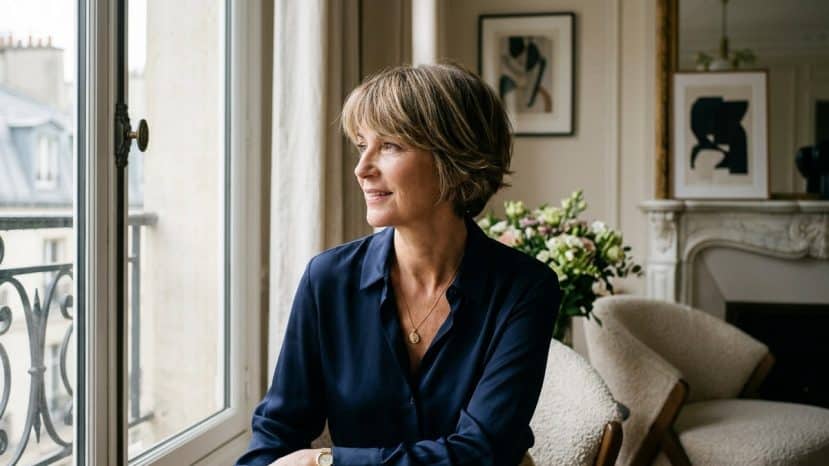


Changing your cut after 50 might seem like a small thing, but the right choice genuinely transforms the way your face reads. Parisian hairdressers are largely in agreement on one style in particular: the wispy curtain fringe, which is gaining ground for its subtle yet effective visual impact.
What a curtain fringe actually does for the face
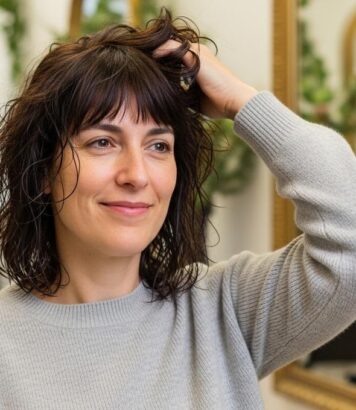
A curtain fringe is defined by its centre parting and the way the strands sweep gradually out to either side. This particular placement leaves part of the forehead visible, which avoids the sharp horizontal cut that a blunt, full fringe can create. The eyes stay open and unobstructed, and the lines framing the face feel fluid rather than severe.
Hairdresser Delphine Courteille, who collaborates with L’Oréal Professionnel, notes that this fringe frames the face by drawing attention to the eyes. Speaking to 20 Minutes, she also points out that it can give the impression of a more youthful face, regardless of age or face shape. It is less about morphology, then, and more about movement: the strands frame without constraining.
That sense of movement is, in fact, at the heart of why this cut works so well after 50. The soft lines it creates stand in contrast to the rigidity of a classic blunt fringe, and the cut can be adapted to different hair lengths and textures.
How Parisian hairdressers tailor this fringe to each client
A curtain fringe is not a fixed formula to be replicated identically on everyone. Its length, thickness and the way it blends into the rest of the cut all need to be adjusted according to hair texture and face shape. A light, feathered version produces a very different result from a thicker, more defined fringe.
In the salon, the priority for Parisian hairdressers is above all to preserve that softness. The fringe can be worked in a wispy, tapered way and then gradually melted into the lengths to avoid a heavy, compact finish. It can also complement a layered cut, which amplifies the movement around the face.
- Centre parting with strands opening out to the sides
- Forehead partially visible to avoid a hard horizontal line
- Length and thickness adjusted to suit hair texture
- Blended into the lengths for a soft, non-bulky effect
- Can be paired with a layered cut for added movement
These adjustments make all the difference between a fringe that weighs the face down and one that lifts it. This work of personalisation is precisely what Parisian hairdressers place at the centre of their approach.
Everyday styling: the professionals’ method
A great curtain fringe does not depend solely on the salon cut. At-home styling plays a decisive role in the final result. Delphine Courteille offers a dedicated tutorial on blow-drying the fringe into shape, built around the principle of working with the hair while it is still damp, in order to guide the strands in the desired direction.
Caroline de Maigret, quoted by Vogue, describes a simple technique of her own: combing the damp fringe successively to the left, to the right, then forward. This repeated gesture produces a soft, slightly undone result, far from a stiff or over-smoothed fringe.
This relaxed aesthetic is, incidentally, a signature that Vogue has long associated with figures such as Charlotte Gainsbourg and Lou Doillon, highlighting the loose, natural quality of this style of fringe. Parisian hairdressers belong to that same tradition: favouring movement over geometric precision.
Why this trend is making its mark in 2026
The curtain fringe is not new, but it is enjoying a notable resurgence of interest, particularly among women over 50 who are looking for a cut that is both easy to maintain and visually effective. Parisian hairdressers recommend it precisely because it does not require a complex styling routine every morning.
Its main asset remains its versatility. It works on short hair as well as longer lengths, and its wispy version suits fine hair just as well as thicker hair. In that sense, Parisian professionals present it less as a passing trend and more as a lasting option, to be personalised according to each person’s needs.