Behind the fashion shows, the magicians who make collections go viral
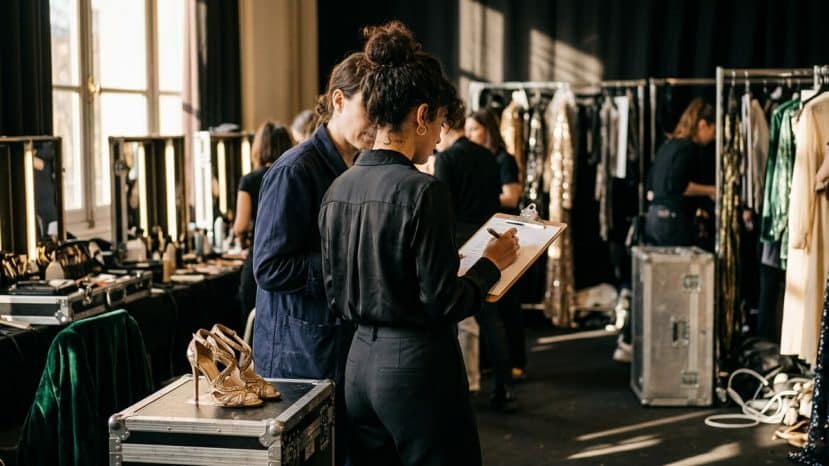


Fifteen minutes on the clock, millions of viewers watching live, and immense pressure for every image to go viral: fashion shows today are far more than simple clothing presentations. Behind each show stands a handful of discreet professionals, set designers and producers, whose work determines the media fate of an entire collection.
Colossal budgets and an extraordinary attention economy
The financial and media scale of fashion shows has reached heights that would have been unimaginable twenty years ago. According to Bruno Pavlovsky, president of fashion activities at Chanel, a study based on the Launchmetrics algorithm revealed that in 2025, the media impact of Women’s Fashion Week was twice that of the Super Bowl. A figure that illustrates just how much these events have become unmissable global moments.
The budgets involved reflect what is at stake: a show costs a minimum of €50,000, and the figures can run to six zeros or more. The Louis Vuitton Men’s autumn-winter 2021-2022 show, staged in Seoul in partnership with K-pop group BTS, drew more than one hundred million viewers in a single event. Yet since 2025 and successive global crises, many brands have been cutting spending on shows in favour of broader image-building.
The equation is not straightforward: a set design that is too powerful can steal the attention that should belong to the collection itself. Manon Renault, a doctor in information and communication sciences specialising in fashion, makes this point clearly. In her research among observers aged 18 to 25, many cited the 2022 Coperni show, where Bella Hadid had a white dress spray-painted directly onto her skin, not for the garment itself, but for the event as a whole, which became a conversational reference point across social media.
Three companies that shape the most spectacular fashion shows
In the world of fashion, three production companies share the bulk of the market. Villa Eugénie, founded in 1994 by Étienne Russo, has produced shows for Dries Van Noten and Moncler, as well as the major Chanel productions during the Karl Lagerfeld era. La Mode en images works with Louis Vuitton Womenswear, Balenciaga and Loewe, and stages around a hundred shows worldwide each year. Bureau Betak, meanwhile, works with houses including Gucci Cruise, Dior Womenswear and Bottega Veneta.
Étienne Russo describes three types of client relationships: those who hand over executive production and ask for their vision to be executed precisely, those who give near-total creative freedom, and those with whom the work evolves through ongoing conversation. In every case, the creative process can last anywhere from six weeks to nearly a year, depending on the scale and location of the project, with moodboards going back and forth between the set designer and the artistic director.
- Décor, lighting and music are the primary tools of set design.
- Rehearsals are now tested through the lens of a mobile phone to anticipate how everything will look on social media.
- Unusual, off-the-cuff venues, a disused metro station, a wasteland, have become almost unthinkable for reasons of security and crowd management.
- Guest lists are tending to shrink to a few hundred people, in a logic of exclusivity and tighter control over brand image.
- A show generates months of marketing content, serving as a backbone for a house’s overall communications, including accessories and cosmetics.
When ingenuity makes up for a tight budget
For emerging brands, staging a fashion show is a financial balancing act. Ester Manas, who launched her house in 2019, experienced this first-hand. In 2024, an ambitious collection paired with a show to match ended in commercial failure. The designer then asked herself the fundamental question: what is the point of a massive investment in an event that lasts only ten minutes?
The answer came in the form of a life-size inflatable elephant, rented from a fairground operator for €400, which became the centrepiece of her spring-summer 2025 collection. This creative masterstroke not only put the brand back on track, but also allowed the designer to hire collaborators and develop her studio. Meanwhile, Marie Adam-Leenaerdt, winner of the Grand Prix de l’Andam, had her guests walk into an empty room for her autumn-winter 2026 show, each one taking a seat on a simple folding stool.
Some houses, however, choose deliberate restraint to refocus attention on the clothes. Jonathan Anderson, for his first Dior Men’s show in June 2025, presented his collection against a strikingly sparse backdrop, with just two small paintings by Jean Siméon Chardin hanging on the walls. A studied simplicity from a designer who is also an art collector, cutting sharply against the grain of the usual spectacular productions.
The shows that have left their mark on fashion show history
Certain moments remain etched in the collective memory of the industry. For Dries Van Noten’s fiftieth show in 2004, Villa Eugénie orchestrated a dinner for five hundred guests around a table one hundred and fifty metres long, with two hundred and fifty waiters coordinated via a system of coloured lights inspired by Formula 1. After the meal, one hundred and fifty chandeliers were hoisted simultaneously, clearing the space for models to walk the table itself, with golf carts ferrying them back to the wings between passes.
Other shows have made their mark through their connection to current events. For his autumn-winter 2022-2023 collection, Balenciaga under Demna sent models walking into an artificial blizzard, an atmosphere directly echoing the climate crisis and the war in Ukraine. More recently, Matthieu Blazy’s first show for Chanel brought fifteen enormous luminous planets orbiting beneath the nave of the Grand Palais, a set design conceived with Arnaud Selve.
For Manon Renault, the industry has now reached a turning point. Some houses are looking to reduce the number of intermediaries producing content, to reclaim control over what circulates around their image, and to return to the clothes themselves, their details and their craftsmanship, rather than multiplying their output in a world already saturated with information.