
Pony.ai promises driverless taxis in Paris within 1 to 2 years
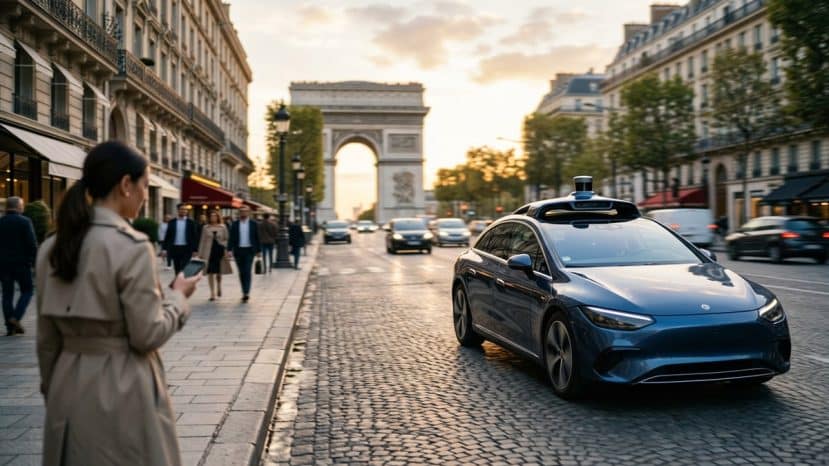


Within one to two years, driverless taxis could be navigating the streets of Paris. This is no longer the stuff of science fiction: Pony.ai founder James Peng said so plainly during a recent visit to the French capital. The rollout of autonomous vehicles in the City of Light is taking shape, and faster than many had anticipated.
Pony.ai, the Chinese giant betting on driverless taxis in Paris
Pony.ai is a company specialising in the development of autonomous driving software, which it then sells to car manufacturers. Its president, James Peng, spoke to Le Parisien following the launch of a pilot autonomous mobility programme in Luxembourg, notably with Bolt, the ride-hailing service.
Buoyed by this European experience, James Peng made his conviction clear: Paris is the next stop. According to him, the streets of Paris should welcome these vehicles “within 1 to 2 years”, as should London. The timeline is therefore far tighter than anyone might have expected.
The rollout is planned in two phases. First, the software will be integrated into imported Chinese electric cars. Then, in a second phase, it will be fitted to European models.
Why these vehicles could be safer than conventional cars
One of James Peng’s central arguments concerns safety. According to him, 90% of road accidents are caused by human error. The algorithms developed by Pony.ai are designed to replicate human behaviour, analyse situations and anticipate them, without ever growing tired or losing focus.
As a result, this technology could significantly reduce the number of accidents. This is precisely the argument that addresses the concerns most commonly raised by prospective users, namely the feeling of insecurity and the need for control.
In France, as across the rest of Europe, these barriers are real. Legislative hurdles, as well as public resistance, have so far slowed the adoption of autonomous driving. Yet testing is accelerating: Tesla has already tested its full self-driving capability over 195,000 km in France, with no notable incidents recorded, according to the company.
What this means in practice for Parisians
For residents of the capital, the arrival of driverless taxis in Paris represents a significant shift in everyday travel habits. These autonomous vehicles could be on Parisian streets within a very short timeframe, according to Pony.ai’s statements.
- A rollout planned within 1 to 2 years in Paris, according to James Peng
- Pony.ai software to be installed first on imported Chinese electric cars
- A subsequent expansion to European models
- A pilot programme already launched in Luxembourg, with Bolt
- 90% of accidents attributed to human error, according to Pony.ai’s president
Furthermore, this deployment is not limited to Paris. London is also cited by James Peng as an upcoming destination for these autonomous vehicles.
A European landscape still taking shape
In Europe, the self-driving car has yet to fully establish itself. The obstacles are twofold: on one side, regulatory frameworks that are slow to adapt; on the other, lingering scepticism among a portion of the public. Entrusting your safety to an algorithm remains a difficult psychological leap for many.
Yet the signals are mounting. The pilot programme in Luxembourg marks a concrete first step for Pony.ai on European soil. And Tesla’s tests in France, covering nearly 200,000 kilometres, show that players in the sector are actively working to reassure governments and insurers alike.
Driverless taxis in Paris no longer belong to the realm of cinematic fantasy, from Knight Rider to Minority Report. They now sit within a defined timeline, driven forward by companies moving at pace. Parisians could well find themselves sharing the road with these vehicles on the Champs-Élysées well before the end of the decade.