Five hairdressers reveal the pixie cuts that take years off after 50 in 2026
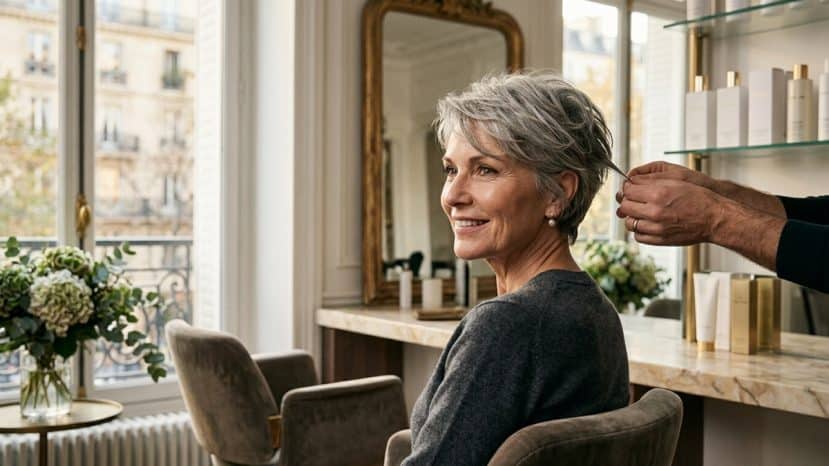


Choosing a short cut after 50 is often the moment of greatest hesitation, with the nagging conviction that length protects and shortness exposes. Yet pixie cuts today offer a far wider and more flattering range of styles than most people imagine. Five renowned hairdressers share their recommendations for 2026, and their advice genuinely changes the game.
Maintenance and daily habits to keep pixie cuts looking their best
Before settling on a style, understanding the upkeep it requires helps you make the right call. For the pixie undercut, hairdresser Samantha Cusick, Olaplex ambassador, recommends applying a small amount of Bond Smoother to the top sections, gently pushing the hair forward, then letting it fall back naturally. The less controlled the result looks, the better the effect.
For curly or textured hair, Maria Sotiriou, co-founder of SILKE London, points out that overnight protection remains worthwhile even with short hair. A silk bonnet reduces friction against the pillow and helps preserve the shape of the cut. This simple step extends the style between salon visits.
For the Winona cut, session stylist Ella Fisher advises blow-drying the hair with a small round brush, directing the layers toward the face, then finishing with a matte texturising wax. This product creates definition and separation without weighing the hair down.
Four pixie cut variations worth knowing
The bixie and the flixie, for a gradual transition
For those who want to ease into short hair without a dramatic leap, the bixie, also known as the pixie bob, is the ideal entry point. Mark Leeson, former British Hairdresser of the Year, recommends it above all for oval and heart-shaped faces. He cites Sharon Stone and Robin Wright as references for this look, which combines freshness with enough length to soften the overall silhouette.
The flixie, meanwhile, is a deconstructed, slightly longer take on the classic pixie. Hairdresser Zoe Irwin describes the style as a pixie in the grow-out phase, with strands that lift naturally at the nape for an unapologetically nineties effect. For women with less density on the sides, very small keratin extensions can be placed strategically to add volume without being detectable.
The pixie undercut and the finger wave, for bolder profiles
Worn by the likes of Tilda Swinton and Jamie Lee Curtis, the pixie undercut creates a strong contrast between the sides and back, cut very close, and the top, left longer with plenty of texture. This style is for those who want a confident, contemporary result.
The finger wave pixie draws its inspiration from the 1920s. The sides and back are cut close to the head, while the top is sculpted into S-shaped waves using a strong-hold gel and a fine-tooth comb. Maria Sotiriou emphasises that this approach works with natural texture rather than against it, which reduces heat exposure. That is a real advantage for hair that becomes finer and more fragile with age.
- The bixie suits oval and heart-shaped faces particularly well.
- The flixie works best on hair with natural movement and texture.
- The pixie undercut creates contrast between shaved sides and a textured top.
- The finger wave pixie reduces heat exposure for fragile hair.
- The Winona cut enhances the natural shades of grey and white.
The Winona cut, the pixie cut that celebrates natural grey
Inspired by Winona Ryder’s signature style, this choppy, textured cut is making a notable comeback in 2026. Ella Fisher highlights how its multiple layers and movement allow the different shades of grey, white and silver to blend harmoniously. The natural variation in the hair becomes a visual asset rather than a flaw to disguise.
This style is therefore ideal for those who want to embrace their grey while wearing a resolutely modern cut. The matte texturising wax Fisher recommends adds definition without weighing the hair down, which works particularly well for hair that has lost density over time.
Why pixie cuts work so well after 50
Mark Leeson makes one central point: the right short cut can add movement, reveal the hair’s natural texture, and draw attention to the eyes and cheekbones. It is not a question of sacrifice, but of personalisation.
The key lies in choosing a shape suited to your face structure, hair type and lifestyle. The variations on the pixie are today softer and more wearable than ever, capable of flattering almost anyone. Whether you prefer a polished, undone, bold or understated result, these pixie cuts adapt to the woman wearing them, rather than forcing her into a mould.