Dopamine dressing dethrones beige in 2026 as colour makes its comeback


What if opening your wardrobe tomorrow morning actually felt like a pleasure? That is exactly what dopamine dressing promises: a way of getting dressed that puts personal feeling back at the heart of every clothing choice. In 2026, this approach is making a powerful return, carried by a broader movement turning its back on years of quiet minimalism.
When fashion psychology meets everyday life
The concept was formalised by Dawnn Karen, an American psychologist specialising in fashion and a lecturer at the Fashion Institute of Technology in New York. In a book published in 2020, she explores the links between clothing choices and state of mind. The idea caught on quickly, particularly in the wake of lockdowns, a period during which wardrobes had leaned heavily towards comfort and neutral tones.
That said, it is worth being careful not to confuse the name with the scientific reality. Dopamine dressing is not built on proof that a colourful garment mechanically triggers a dopamine release in the brain. The most credible explanation actually comes from embodied cognition, an approach that studies how what we wear can influence our thoughts, our behaviour and our perception of ourselves.
In plain terms, an outfit can help establish a certain state of mind. But it is not purely a question of colour. It is also about what a piece means to you, the way you wear it and the feeling it gives you the moment you put it on.
Three practical ways to embrace dopamine dressing
Good news: there is no need to turn your wardrobe into a colour festival to enjoy this trend. Several entry points make it easy to adopt naturally, depending on your style and your appetite for boldness.
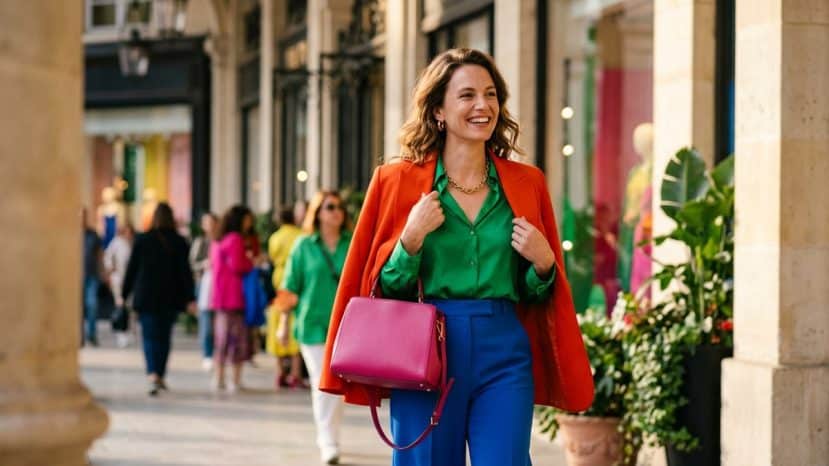
- Invest in one statement piece: a striking coat, a colourful bag or a pair of bold shoes is enough to lift a neutral outfit without overhauling the whole look.
- Try a monochrome moment: wearing several pieces in the same strong shade can sound dramatic, but the result is often surprisingly harmonious, since you are staying within a single colour family.
- Play with textures: a cocooning velvet, a tactile knit or a luminous satin can also bring a sense of pleasure and give a silhouette real character, without reaching for vivid colours at all.
- Choose what feels like you: there is no universal colour chart for sartorial happiness. If you feel great in deep blue or burgundy, those colours are entirely valid.
This freedom of choice is, in fact, one of the most interesting aspects of the trend. The goal is not to swap one aesthetic constraint for a new set of rules, but to put your own feelings back at the centre of your decisions.
From the runway to the street, colour reclaims its place
In 2026, collections reflect this change of direction. Orange coats, lavender knitwear, lemon-yellow accessories: bold tones are reclaiming silhouettes after years dominated by beige, grey and camel. But the phenomenon is not confined to the runway.
Street style has embraced it with enthusiasm, sometimes even before designers announce their trends. Because this new sartorial freedom also has a very tangible practical effect: it turns the wardrobe into a playground rather than a list of rules to follow. That familiar feeling of having nothing to wear gives way to a genuine desire to experiment.
What this trend really changes for you
Dopamine dressing makes most sense when you make it your own rather than simply obeying it. You are not obliged to wear yellow because it is considered cheerful, or pink because it evokes softness. What matters is the feeling you get when you slip on a piece, not the colour that trends are telling you to wear.
This is neither a miracle formula nor a treatment. Above all, it is an invitation to look at your clothes differently. A piece can be comfortable, flattering, expressive or simply make you smile. And what if the best outfit was, in the end, simply the one that makes you feel good in your own skin?