Galerie Colbert reopens after 3 years of restoration, the hidden gem of the 2nd arrondissement


Imagine a royal stable yard transformed into one of Paris’s most elegant covered passages. That is exactly the story of the Galerie Colbert, tucked into the 2nd arrondissement between rue des Petits-Champs and rue de la Banque. After three years of works carried out from 2022 to 2025, this place of extraordinary destiny reclaims its full splendour in 2026.
An architectural palimpsest at the heart of Paris
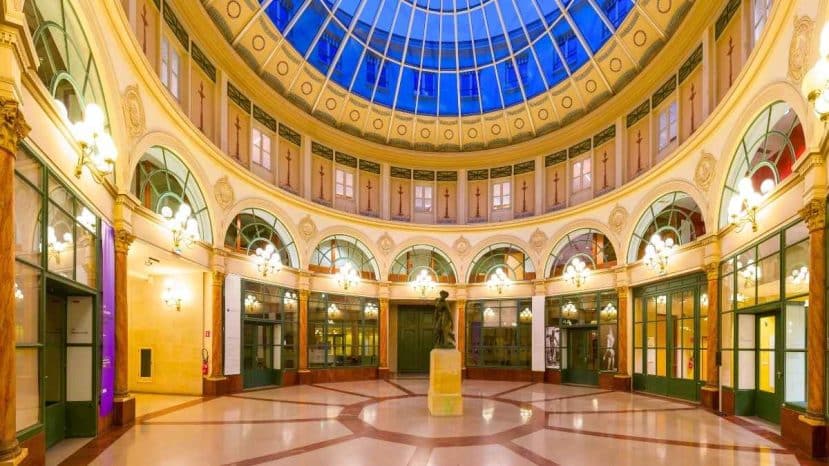
Few Parisian spaces have lived as many lives as this passage. In the 18th century, the site housed the stables of Philippe d’Orléans, regent of the kingdom. In 1826, the firm Adam et Compagnie purchased the property from the state and entrusted architect J. Billaud with an audacious brief: to transform this utilitarian courtyard into a shopping arcade. The result was breathtaking. Billaud erected a vast rotunda crowned with a glass dome, stretching 83 metres in length, lined with faux-marble half-columns and adorned with polychrome motifs. At its centre stood a bronze candelabra bearing seven gas-lit crystal globes, nicknamed the “luminous coconut palm”, which quickly became the go-to meeting point for romantic rendezvous during the July Monarchy.
Yet the rise of the grand boulevards and department stores soon undermined this model. In 1873, the owners decided to demolish the original building, deemed insufficiently profitable. From 1874, architect Henri Blondel rebuilt a more monumental structure in a neo-Renaissance style, incorporating offices, shops and institutions. The candelabra disappeared, replaced by an 1822 bronze statue by Charles-François Nanteuil-Lebeuf depicting Eurydice bitten by a serpent. Despite this ambitious reconstruction, the arcade continued to decline and closed its doors for good in 1975.
The Bibliothèque nationale subsequently acquired the passage and commissioned architect Adrien Blanchet to carry out a restoration completed in 1986, faithful in spirit to the 19th century. It was at this point that the space shifted definitively towards culture and heritage, leaving commercial logic firmly behind.
The 2025 renaissance: an urban campus dedicated to art history
The latest transformation is also the most ambitious since the 1874 reconstruction. From 2022 to 2025, the practice of Pierre-Antoine Gatier, chief architect of historic monuments, and designer Constance Guisset led a three-year project to breathe new life into the passage without betraying its soul. The oil-painted faux marbles, decorative schemes and all surface finishes were treated using artisanal techniques, in a conservation approach that honours every historical fragment.
Constance Guisset designed furniture conceived to encourage conviviality between the columns: long benches slot into a colour palette that extends the gallery’s own chromatic harmony. Acoustic and wayfinding lintels punctuate the space, echoing the covered arcades of the 19th century. In the rotunda, a monumental chandelier descends from the glass roof, composed of luminous spheres and acoustic spheres in dialogue with the existing light fittings. On the floor, sofas follow the concentric lines of the rotunda, turning this space into a genuine living square.
A new reception area takes shape around the remains of the Hôtel Bautru, in the hall named Rose Valland in tribute to the wartime resistance figure. A café has opened in the rotunda, whose return gallery faces the garden of the Bibliothèque nationale de France.
What you will find in the Galerie Colbert today
This passage stands apart from all its Parisian counterparts by one rare distinction: it contains no commercial shops whatsoever. Entirely devoted to culture, it now brings together the Institut national d’histoire de l’art (INHA), the Institut national du patrimoine (Inp) and several university research departments in art history from Parisian and Île-de-France institutions. Master’s students, French and international researchers, and heritage professionals all find here an urban campus designed for exchange and scholarship.
The rooms bear the names of great figures in art history and archaeology: Guillaume Guillon Lethière, Walter Benjamin, Roberto Longhi, Aby Warburg, André Chastel. Each space becomes a living tribute to those who shaped the discipline.
- The Rose Valland hall, dedicated to the resistance figure, now houses the main reception area.
- The renovated rotunda is home to a café open to passing visitors.
- The restaurant Le Grand Colbert, a brasserie with a listed Art Nouveau interior, is located at the entrance on the rue des Petits-Champs side.
- The Bibliothèque nationale de France sells postcards, posters and books on site.
- Regular events are held here: lectures, screenings and debates, particularly during the Journées européennes du patrimoine and the Nuits de la lecture.
For lovers of history and architecture, the gallery also offers a peaceful alternative to the neighbouring Galerie Vivienne, which tends to draw larger crowds. The passage remains open to everyone, strollers and curious minds alike, true to its original vocation as a thoroughfare cutting through the city.
An anecdote that transforms how you see the rotunda
In 1830, Berlioz is said to have performed La Marseillaise from one of the gallery’s windows, in the revolutionary spirit that gripped Paris at the time. This detail illustrates just how much this passage has always been far more than a simple place for shopping or strolling. In the 19th century, it also housed a literary cabinet with a library of 15,000 volumes, a sign that cultural ambition was present here from the very beginning.
Its architectural principle, notably the rotunda as a crossing point between the aisles, went on to inspire architects across Europe. This international influence, often overlooked, speaks to the reach that this Parisian passage exerted well beyond its 83 metres. Situated between place des Victoires and the garden of the Palais-Royal, in a neighbourhood exceptionally rich in heritage, this jewel of the 2nd arrondissement is well worth the detour.