
The most ordered dessert at French restaurants is not what you’d expect


Every evening, thousands of French diners hesitate over the dessert menu, convinced they already know what they want. Yet a major national survey, reported by Tribunal du Net, reveals that what people actually order contradicts received wisdom entirely. The dessert that wins out at French restaurants is neither crème brûlée nor tiramisu, but something far older and far more generous.
The profiterole: the undisputed winner of the restaurant dessert
It is the profiterole that comes out on top of this national ranking, well ahead of all its rivals. This dessert brings together crisp choux pastry filled with vanilla ice cream and drenched in a piping-hot chocolate sauce. The contrast between hot and cold, combined with the crunch of the pastry, delivers an immediate sensory hit that very few diners can resist at the end of a meal.
This success is no accident. In brasseries and bistros, the profiterole simply crushes the competition and claims the top spot on the podium. Its visual and gustatory generosity answers exactly what diners are looking for today: comfort, contrast, and bold sensation.
A ranking that upends the conventional wisdom
Behind the profiterole, the ranking holds a few more surprises. Chocolate tart takes second place and has become the go-to choice for the 25-35 age group. Tarte Tatin, meanwhile, wins over fans of comforting flavours and claims third place on the podium.
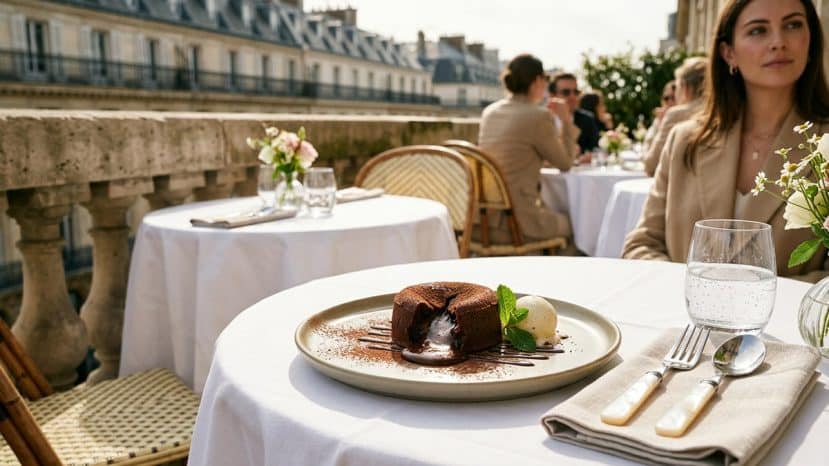
Further down the list, the molten chocolate fondant sits in fourth position. Its flowing centre, revealed at the first cut, has become a visual ritual widely shared on social media. This phenomenon illustrates just how central aesthetics have become to choosing a dessert at a restaurant.
- Tiramisu holds 5th place thanks to its reassuring texture.
- The cheese board, favoured by older diners, takes 6th place.
- Crème brûlée, often cited as the ultimate classic, fails to climb beyond 7th position.
- Chocolate mousse closes the ranking in 8th place, held back by its image as a default dessert.
This ranking shows that the desserts people mention most readily are not necessarily the ones that actually prompt an order. Pastries perceived as too technical or too formal are losing ground to more spectacular offerings.
What this ranking means in practice for restaurateurs
For hospitality professionals, the profiterole’s dominance also rests on very practical arguments. The dessert has a manageable food cost and can be plated quickly in the kitchen, making it a flagship product for establishments looking to balance profitability with guest satisfaction.
More broadly, the ranking highlights a marked shift in diner behaviour. Offerings built around visual drama, textural contrast, and unapologetic indulgence are clearly pulling ahead. For chefs and brasserie owners alike, adapting their menus to meet this appetite for generosity has become essential.
The end of the meal: a moment of spectacular indulgence
What this ranking confirms is that the end of a restaurant meal has become a fully-fledged experience in its own right. Diners are no longer simply looking to finish their plate: they want a moment, a surprise, a strong sensation. The combined success of the profiterole and the molten fondant is the clearest proof of that.
The profiterole thus cements its status as the undisputed queen of the French table. It pairs profitability for the owner with unabashed, almost childlike pleasure for the guest, a rare combination that very few desserts manage to pull off. For anyone still hesitating over the menu, this 2026 ranking gives a clear answer: the profiterole remains the number-one choice of French diners.