
Why your hairbrush is sabotaging your most expensive hair treatments
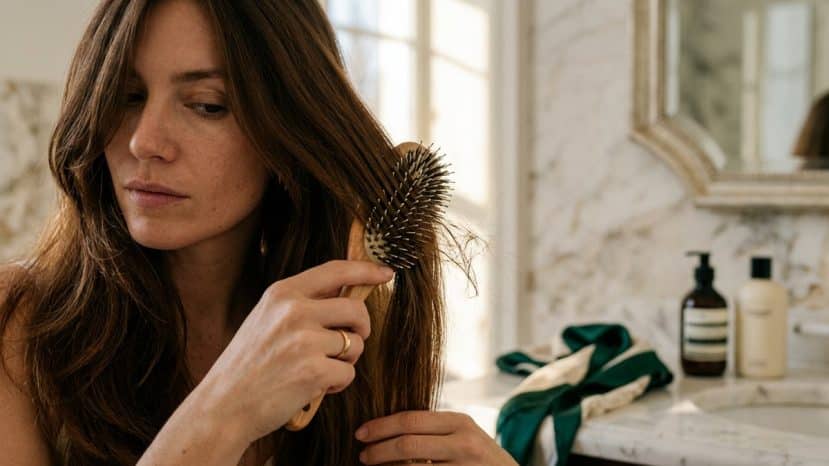


You’ve just washed your hair, applied a pricey treatment, and yet the results are still disappointing. The culprit might be hiding in an accessory you reach for every single morning without ever really cleaning it: your hairbrush. One overlooked habit that can make all the difference to your hair.
What your hairbrush is really collecting between the bristles
Most people assume that trapped strands are the only issue. In reality, a hairbrush holds onto far more than that. Penelope Cheshire and Matt Lumb, founders of the brand Killabrush, explained in the pages of Grazia UK that it also collects sebum produced by the scalp, bacteria, and residue left behind by styling products.
Over time, this mixture forms a greyish build-up visible between the bristles. On TikTok, tens of thousands of videos brought this phenomenon to light in 2026, turning the topic viral. That discreet fuzz is therefore not just an aesthetic issue: it has direct consequences for the condition of your hair.
Because every time you run a dirty brush through freshly washed hair, it redistributes that build-up along the entire length. Shampoo loses its effectiveness, roots get greasy faster, and lengths feel heavy. In other words, the treatments you carefully apply are partly cancelled out by this grimy accessory.
Why hairbrush maintenance is so often overlooked
We happily invest in repairing masks, volumising serums, or eye-wateringly expensive smoothing treatments. And yet the accessory that touches our hair every day is rarely washed. This paradox is at the heart of the viral trend observed on TikTok: many people simply don’t know that a brush needs a proper clean, not just a quick pull of tangled strands.
Removing hair by hand is, in fact, not enough. Sebum, bacteria, and product residue remain lodged in the cushion and between the bristles, invisible but very much present. This is precisely what the experts at Killabrush point out: a simple detangle does nothing to actually sanitise the accessory.
How to clean your hairbrush properly
The good news is that the method is simple and quick. Here are the steps to follow for a thorough clean:
- Start by removing tangled hair by hand or with a fine-tooth comb.
- Submerge the hairbrush in lukewarm water with a small squeeze of shampoo.
- Gently scrub to dislodge the build-up accumulated between the bristles.
- Rinse thoroughly under clean water.
- Leave the brush to dry bristles-side down, so water doesn’t pool in the cushion.
That last point matters: drying a brush the wrong way up can leave moisture trapped in the cushion, encouraging bacterial growth. Placing the accessory bristles-down allows water to drain away naturally.
How often you should actually do it
The recommended frequency is clear: every one to two weeks. This rhythm prevents sebum and residue from building up to the point where they start affecting your hair.
For those who use a lot of styling products, or whose scalp produces more sebum, leaning towards a weekly schedule is advisable. Waiting several weeks between cleans, on the other hand, gives build-up plenty of time to settle deep into the bristles.
Making this simple habit part of your routine is, ultimately, giving all your other hair treatments a real chance to work. A clean hairbrush doesn’t replace a good mask, but it at least stops working against it.