Guerlain reinvents its cult 1912 fragrance L’Heure Bleue in a new bottle at €117


Picture a bottle sitting on a dressing table, unmistakable with its inverted heart, now dressed in a gradient of blues that mirrors the sky at dusk. That bottle belongs to the new Guerlain perfume L’Heure Bleue, reinterpreted in 2026 by perfumer Delphine Jelk, more than a century after its original creation in 1912.
A redesigned bottle for a Guerlain perfume rooted in time
The inverted heart conceived in 1912 remains at the centre of the design, but it now unfolds in a gradient of blues evoking the sky at the moment of twilight. This visual choice is far from arbitrary: it directly reflects the inspiration that originally guided Jacques Guerlain, namely that precise instant when daylight gradually surrenders to night.
For the consumer, this means that both versions coexist within the Guerlain universe. The original remains available in the Les Légendaires collection, while this new interpretation offers a different way of approaching the same fragrance. This is not a replacement, then, but a conversation between two eras.
This Guerlain perfume is available at a price of €117 as an eau de parfum.
Iris at the heart of three years of research
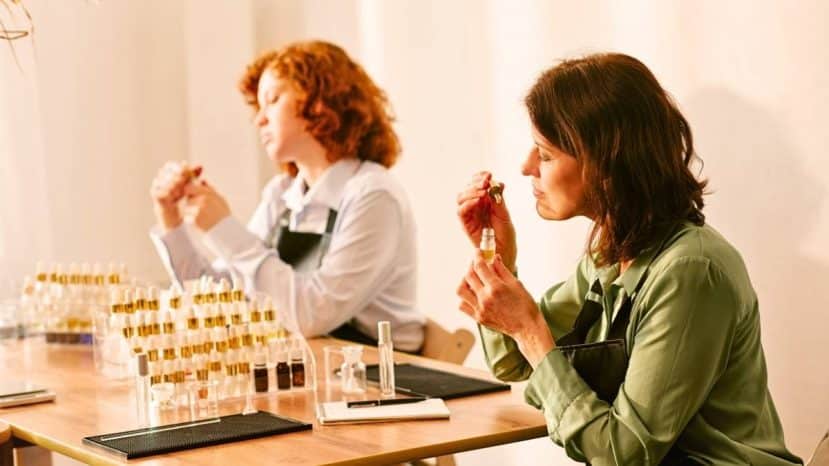
To build this reinterpretation, Guerlain developed an exclusive iris tincture. The work mobilised the teams at the Orphin manufacture for three years. Iris rhizomes are selected in Italy, then macerated in alcohol to extract their scent.
This maceration technique reveals a fresher, more airy facet of iris, quite different from what other extraction methods would produce. It is precisely this quality that gives the composition its sense of lightness, the guiding thread running through Delphine Jelk’s entire creation.
Iris is therefore not simply one ingredient among many in this Guerlain perfume: it forms the backbone, the point around which the entire olfactory structure is organised.
A composition in three movements, from fresh to warm
The structure of this new version unfolds in several distinct stages. Here is how the fragrance builds from start to finish:
- An ozonic accord on the opening, creating a sensation of fresh air from the very first seconds.
- Iris at the heart, with its soft, powdery facet drawn from the exclusive tincture developed at Orphin.
- Orange blossom, which brings luminosity to the central part of the composition.
- Vanilla in the base, gradually warming the sillage.
- Ambroxan at the base, paired with vanilla to extend and anchor the warmth of the dry-down.
This progression from fresh to warm serves a precise idea: to make the fragrance lighter and more airy than the 1912 version, while preserving its deep identity. Orange blossom plays a balancing role here, illuminating a heart that might otherwise have felt too powdery.
Delphine Jelk and the legacy of a historic Guerlain perfume
Entrusting the reinterpretation of such an iconic fragrance to a perfumer is a meaningful act. Delphine Jelk takes up Jacques Guerlain’s founding idea, capturing the particular light of the blue hour, and translates it with contemporary tools and sensibility.
The result is a version that makes no attempt to erase the original. On the contrary, the coexistence of both bottles within Guerlain invites us to compare two readings of the same moment, separated by more than a century. For anyone discovering this Guerlain perfume for the first time, this new interpretation offers a more accessible entry point thanks to its lightness. For devotees of the historic version, it stands as an intriguing variation on a familiar theme.
This Guerlain perfume illustrates how a house can honour its heritage without freezing it in place, opening new chapters without erasing those that came before.