
I tried the €14 Opéra cake at Dalloyau Faubourg Saint-Honoré, finally back after years away
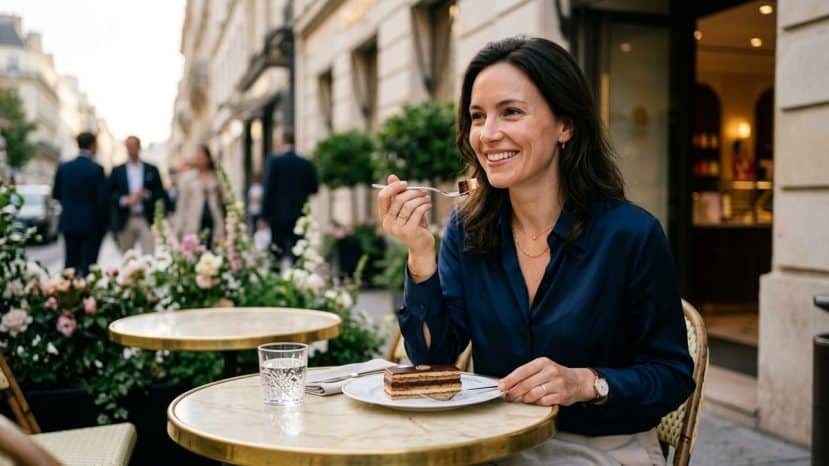


Imagine a slice of Opéra set before you in the very salon where it was born in 1955: that is exactly what Dalloyau Faubourg Saint-Honoré now offers, having reopened this autumn 2026 after several years of closure. Taken over in 2024 by Groupe Potel et Chabot, the house founded in 1682 has reclaimed its historic address at 101 rue du Faubourg-Saint-Honoré, in the 8th arrondissement of Paris, with a completely reimagined interior and a menu overhauled from top to bottom.
A place steeped in history, a long-awaited reopening
It all begins at Versailles. In 1682, Charles Dalloyau served as an officier de bouche at the court of Louis XIV, a title that then designated the very elite of French gastronomy. More than a century later, in 1802, his descendant Jean-Baptiste Dalloyau founded his own house and set up on the rue du Faubourg-Saint-Honoré, at the address we know today. There, he invented a concept that now seems entirely ordinary: offering Parisian bourgeois society ready-to-serve dishes to enjoy at home, just as the great aristocratic households did. Takeaway, nineteenth-century style.
The house then navigated the decades, not without difficulty, before being forced to close several Parisian boutiques from 2018 onwards. The takeover by Potel et Chabot in 2024 marks a genuine turning point. And there is a pleasing detail: Saint Honoré, who gives the street its name, is the patron saint of bakers and pastry chefs. It would be hard to dream up a better address for a house devoted to indulgence.
A reimagined interior for Dalloyau Faubourg Saint-Honoré
For this reopening, the Maison entrusted the interior design to Tihany Design. The result leans into understated luxury: Versailles parquet, mouldings, alabaster, brass, solid oak and Calacatta Oro marble come together to create a hushed atmosphere reminiscent of a private mansion’s drawing room. The colour palette has changed radically, and the tea salon now sits at the far end of the long, open space rather than upstairs as it once did.
From the entrance, a breakfast and coffee-shop area greets you with the scent of freshly baked pastries. Opposite, a bakery counter and sandwiches catch the eye. The pâtisseries are showcased in the display case immediately to the right as you walk in. On the façade, the house’s dark arcades and pale blue livery have been restored to their original look. Compared with the 2021 iteration, which leaned into urban art, the space has returned to a classical elegance designed to endure.
Under this one roof now coexist a boutique, a boulangerie, a chocolaterie, a biscuiterie, a takeaway counter, a tea salon and a chef’s table available for private hire, not forgetting the terrace.
Mathilda Fouré and the pastries you absolutely must try
At the helm of the sweet creations, Mathilda Fouré took charge of the pastry kitchen after stints at the houses of Yannick Alléno, Troisgros and Bernard Loiseau. Her approach: less sugar, finer textures, without betraying the original recipes. Everything is made in-house, between the laboratory in Sèvres, in the Hauts-de-Seine, and the Faubourg boutique.
At the front of the display, the Opéra takes its rightful place. This layered cake of Joconde sponge, coffee buttercream and chocolate ganache was born here in 1955, conceived by Cyriaque Gavillon. It was his wife Andrée who named it, in homage to the Palais Garnier. It returns alongside the Dalloyau and the Saint-Honoré, at €14 a slice. The display case also features a Millefeuille, a Royal Chocolat, a Fraisier, the Paris-Versailles, a coffee or chocolate Religieuse, a lemon meringue tart and a seasonal fig tart. Prices range from €8 to €14 depending on the cake. A flaky Parisian flan and coffee or chocolate éclairs round out the offering.
- The Opéra, born here in 1955: €14 a slice
- Millefeuille, Royal Chocolat, Fraisier, Paris-Versailles: from €8 to €14
- Breakfast du 101 with organic eggs: €25
- Tea-time du 101 (two savoury bites, mignardises, gianduja brioche): €40
- Weekend brunch du 101: €50
From breakfast to tea-time, what the tea salon has to offer
The tea salon runs from morning to evening. In the morning, the Parisian breakfast brings together freshly squeezed orange juice, a hot drink, mini viennoiseries and a small baguette with salted butter, jam or house-made praline. The breakfast du 101, at €25, adds organic eggs cooked to your liking. The flaky Saint-Honoré brioche with gianduja is already shaping up to be a future signature of the house.
At lunch, the savoury menu plays the classics of Parisian cuisine, executed with care: a club sandwich with free-range Landes chicken, a croque-monsieur with Prince de Paris ham and 18-month comté, a Caesar or Niçoise with Ortiz tuna belly, a Parisian quiche, avocado toast or blue lobster pasta. Salads hover around €25, the lobster pasta at €35. At weekends, the brunch du 101 at €50 moves through freshly pressed juice, a hot drink, mini viennoiseries, a main course of your choice and a sweet finish. Children up to 10 have their own menus: lunch at €20, brunch at €25 and tea-time at €20, built around a Croque-mignon and a cookie-crumble ice cream coupe.
Every day from 3pm to 6pm, the tea-time du 101 at €40 offers two savoury bites, three mignardises, a glazed Arlette and the gianduja brioche. A generous moment, ideal after a stroll past the Palais de l’Élysée or before a shopping session on the Faubourg, with the Champs-Élysées just a few minutes’ walk away.
Practical information for visiting Dalloyau Saint Honoré
The Dalloyau Faubourg Saint-Honoré boutique is located at 101 rue du Faubourg-Saint-Honoré, in the 8th arrondissement. The nearest metro stations are Miromesnil (lines 9 and 13) and Saint-Philippe-du-Roule (line 9). Brunch is served on Saturdays and Sundays from 11am to 3pm, and tea-time every day from 3pm to 6pm. The chef’s table can be reserved for more intimate occasions. For a first visit to Dalloyau Saint Honoré, a jambon-beurre, a slice of Opéra and a coffee are all you need to grasp the essence of this rediscovered Parisian institution.