
Quiet luxury: three anti-palace hotels in Rome, Bali and Mexico for a different kind of travel


Quiet luxury first conquered fashion by putting logos in the closet. This trend celebrates discreet luxury, craftsmanship and noble materials. Now, high-end hotels are embracing this much-appreciated silence.
Gone are the lobbies with their gleaming chandeliers and gold-veined marble. A new wave of ultra-luxuryaddresses is playing a radical score: raw, local, authentic. These hotels are among the most coveted of the moment.
The anti-palace: when luxury renounces traditional codes
Less glitz, more meaning. Less show, more territory. That’s the promise of these establishments that are reinventing the travel experience. Paradoxically, renouncing the codes of luxury seems to be the most luxurious thing there is.
Hand-worked plaster walls in Rome. Clay bricks made in a neighboring village in Bali. Solar concrete villas rising from the ground in Mexico. Three hotels, three continents, one conviction: true luxury has nothing left to prove.
“Nomos doesn’t seek to impress, it seeks to stay. In the memory, in the senses, in that rare impression of having stayed somewhere true.”
Nomos Hotel in Rome: austerity as a form of grace
In an alleyway in Rome’s historic center, a stone’s throw from the Campo de Fiori, there are no flashy signs. Just a stone façade and a discreet door. The Nomos Hotel occupies a former 18th-century Franciscan monastery.
Henry Timi, a Roman designer and craftsman, has created his first hotel. All he has retained from the monastic spirit is austerity as a form of grace. Hand-worked plaster adorns the walls. The floors are made of terrazzo cast on site and terracotta made in Rome.
- Raw plaster and travertine: local materials worked by hand
- Clay bricks: produced in neighboring villages
- Solar concrete: a building that blends into the landscape
- Woven linen and simple wood: decorating without artifice
- 100% solar power: a concrete environmental commitment
Further Hotel in Bali: living in the heart of the village
In Pererenan, no one will tell you where the hotel is. The Further Hotel doesn’t exist as a classic hotel. It exists as a neighborhood. Four separate buildings are scattered throughout the village’s alleyways.
Architecture doesn’t seek to impose itself on the landscape. It seeks to resemble it. The facades are clad with handmade clay bricks produced in Tabanan. Laid in staggered rows, they create a natural claustra that filters the light.
Inside, the decor incorporates a “luxurious restraint”: dark linen, patinated leather, travertine and raw wood. Beds are built into the floor. Bathrooms open onto planted patios. The Further Hotel is a perfect example of the quiet luxury spirit applied to the hotel business.
Prestigious awards for an innovative concept
The Further Hotel was honored by Condé Nast Traveler in 2024. It was also voted Best New Hotel in the World by Elle Decor in 2023. Yet this address looks nothing like a traditional palace.
You come here to cross Pererenan like a local. We have coffee at ST. Ali. Greet the neighbors before walking back to your suite. This is anti-resort in all its glory.
Hotel Terrestre in Mexico: villas sprung from the earth
Twenty-five kilometers north of Puerto Escondido, on the Oaxacan coast, stand fourteen concrete and brick villas. They look as if they’ve always been there. Mexican architect Alberto Kalach laid down a simple, radical rule.
Everything that goes into building the hotel has to come from within a one-kilometer radius. Or manufactured on site. Concrete, mud bricks, wood, earth: nothing is imported. The villas are 100% solar-powered.
No air-conditioning either. The design of the buildings naturally regulates the temperature. The interior furnishings are by Oscar Hagerman, a Mexican designer who has been working with local craftsmen for fifty years. This place embodies quiet luxury in its purest form.
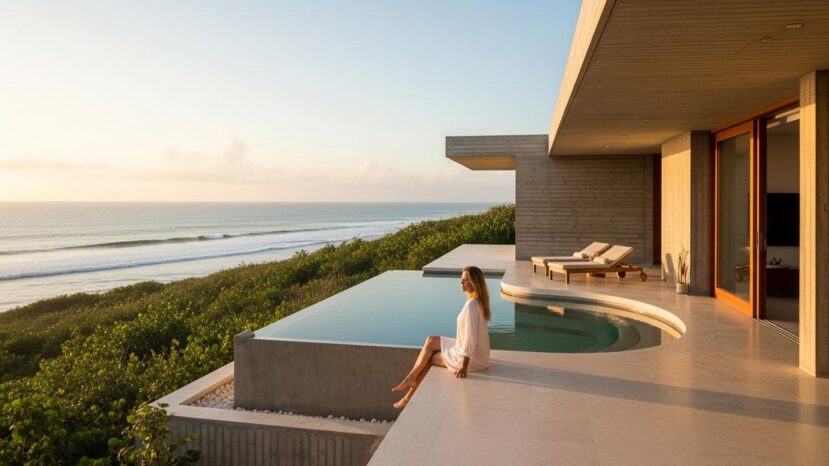
Each villa has its own garden on the first floor. An outdoor shower completes the experience. On the roof, a terrace with private pool faces the Pacific Ocean and Sierra Madre. In the evening, there’s no lively bar or DJ set. Instead, there’s the sound of the jungle and a sky free of light pollution.