Just outside Paris, Seine-Saint-Denis is home to four bike routes that completely change the way you see the 93
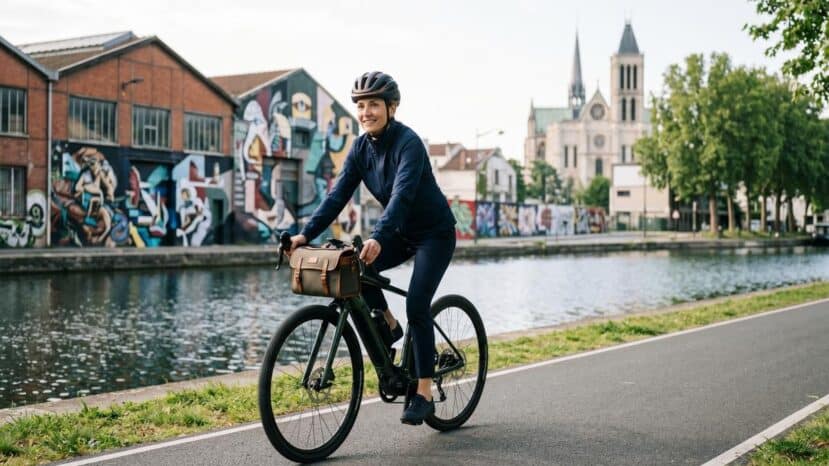


The 93 has plenty of surprises in store for those who venture there on two wheels. Seine-Saint-Denis offers four cycling routes that combine street art, royal heritage, large parks, and rural riverbanks—all accessible from Paris by public transportation.
A robust cycling network on the outskirts of the capital
The department now has more than 184 kilometers of bike lanes on its road network. These lanes consist of 120 km of permanent facilities and 64 km of temporary facilities that are in the process of being made permanent. The “100% Bicycle-Friendly” plan, launched in 2019, aims to adapt the 342 kilometers of departmental roads for bicycle use by 2030.
The 2024 Paris Olympic Games have further accelerated this transformation: an additional 14 kilometers were created for the Games, and 8 new kilometers were developed or made permanent in 2025. As a result, cycling conditions are safe and separated from motor vehicle traffic along the vast majority of the routes.
In addition, the Saint-Denis Canal and the Ourcq Canal are two major waterways that directly connect Paris to the department. The RER, metro, and tram stations located at the departure points make it easy to travel back and forth for day trips.
Four courses, four atmospheres
The first route connects the Saint-Ouen Flea Market to Street Art Avenue over a distance of about 15 km. It runs along the banks of the Canal Saint-Denis, where, since 2016, more than 40 monumental works have dotted the 5 km stretch between the Stade de France and Parc de la Villette. These murals, created by French and international artists, cover walls, bridge piers, and industrial facades.
Just a few pedal strokes away, the Cathedral Basilica of Saint-Denis stands out with its Gothic architecture. Built as early as the 5th century over the tomb of Saint Denis, it became the burial place of the kings of France. More than 70 royal recumbent statues and tombs rest there, dating from the Merovingians to the Capetians. The Parc de la Légion d’honneur, a 24-hectare park partially open to the public free of charge, offers a lush green retreat near the Stade de France.
“Just outside Paris, Seine-Saint-Denis is proving to be an underrated and surprising destination for cyclists.”
The second trail connects Île Saint-Denis to La Courneuve over a distance of about 20 km. It begins in a 23-hectare park designated as a Natura 2000 site, nestled between the two branches of the Seine. From the developed riverbanks, visitors can spot herons and great cormorants.
The route then leads to Georges-Valbon Park, the third-largest green space in Île-de-France at 417 hectares. This green oasis spans five municipalities—La Courneuve, Saint-Denis, Stains, Dugny, and Garges-lès-Gonesse—and is home to a rose garden with 15,000 rose bushes, an educational vegetable garden, and an apiary. However, the route doesn’t end there: in La Courneuve, the Étoile movie theater and the mural commemorating the “March for Equality and Against Racism” bear witness to the area’s cultural vitality.
- From the Saint-Ouen Flea Market to Street Art Avenue: 15 km, easy, street art, and royal heritage
- From Île Saint-Denis to La Courneuve: 20 km, easy, large parks, and a legacy of the working class
- Along the Ourcq Canal, starting in Pantin: 25 km, moderate, urban scenery and nature
- The banks of the Marne in Neuilly-sur-Marne: 18 km, easy, idyllic setting, and protected wildlife
- All routes are suitable for electric bikes (e-bikes) and accessible by RER, metro, or tram.
The Ourcq Canal and the banks of the Marne: two very different getaways
The third route starts in Pantin and follows the Ourcq Canal eastward for 22 km on completely flat terrain. The canal banks are home to open-air cafés, floating bars, and the Cité Fertile, an eco-friendly “third place” housed in former warehouses. As you continue toward Bobigny and Bondy, street art murals line the industrial facades.
In Sevran, the Parc de la Poudrerie is a premier nature destination. This 137-hectare site has a unique history: formerly a gunpowder and explosives factory, it operated from 1873 to 1973 before being converted into a forest park. The Ourcq Canal runs through it, creating a peaceful setting where a few industrial buildings still stand. The trail ends in the Bondy Regional Forest, a 170-hectare woodland that was once a hunting ground for the kings of France.
The fourth trail follows the banks of the Marne from Neuilly-sur-Marne. The flat route follows the old towpaths lined with plane trees. It leads to the Parc de la Haute-Île, a 65-hectare nature reserve designated as a Natura 2000 site, where six observation huts on stilts allow visitors to spot kingfishers, short-eared owls, and meadow pipits. In the heart of the park, the Archéosite recreates the ways of life from the Paleolithic to the Neolithic periods along these very same banks.
Directions and Practical Tips Before You Go
Don’t have your own bike? The Vélib’ Métropole service offers 18,200 bikes—40% of which are electric —at 1,452 stations in Paris and the Île-de-France region. For long-term rentals, Véligo rents electric bikes starting at €10 per month, with maintenance included.
All of the starting points are easily accessible. You can reach the Saint-Ouen Flea Market from Porte de Clignancourt (Metro Line 4). For Île Saint-Denis, the Épinay-sur-Seine (RER C) or Rose Bertin (Tram T8) stations are convenient. Pantin is accessible via the RER E, Metro Line 5, or the T3b tram. The banks of the Marne can be reached from Neuilly-Plaisance (RER A) or Chelles-Gournay (RER E).
Before you set out, be sure to bring a helmet, a bike lock, a water bottle, and a repair kit. Spring and fall are still the most pleasant seasons, but the trails are maintained year-round, including in winter.