Hermès Unveils Its Bond Street Boutique in London: A 17-Year Wait, 55 Rooms, and a Village Designed by Foster + Partners


On June 16, 2026, a long-awaited London location opened its doors on one of the world’s most prestigious shopping streets. The Faubourg Saint-Honoré boutique has just set a major milestone in European luxury, with an opening that goes far beyond that of a simple retail location. This project, nearly two decades in the making, marks a new chapter in Hermès’ history in London.
It took seventeen years to build the Bond Street House
In 2009, the company purchased the freehold of 166 New Bond Street for 73 million pounds—at the time, one of the highest prices ever paid for a property on Bond Street. It took seventeen years for this real estate venture to become an architectural reality. Yet each passing year seems to have fueled the project’s ambition.
The Bond Street Maison is now the brand’s largest store in Europe and the sixth Hermès Maison worldwide. This status places it in a class of its own, alongside the few locations that define themselves not as boutiques, but as living spaces.
The complex comprises six Grade II-listed Georgian buildings: 165, 166, and 167 New Bond Street; 16 Grafton Street; and 22 and 23 Albemarle Street. These buildings were constructed in 1769 by the neoclassical architects Sir Robert Taylor and R.J. Worley. For over a century, they were the home of the Asprey company.
“It’s not a store. It’s a village.” — Pierre-Alexis Dumas
An Exceptional Architectural Project
The space spans 2,000 square meters across five levels, featuring 55 rooms, each with its own distinct character, four staircases, four elevators, and two rooftop terraces. As a result, every corner offers its own unique atmosphere, a far cry from the uniformity of large commercial spaces. The interior design was entrusted to RDAI (Rena Dumas Architecture Intérieure), under the direction of Denis Montel, a long-standing partner of the brand who has been involved in this project since 2021.
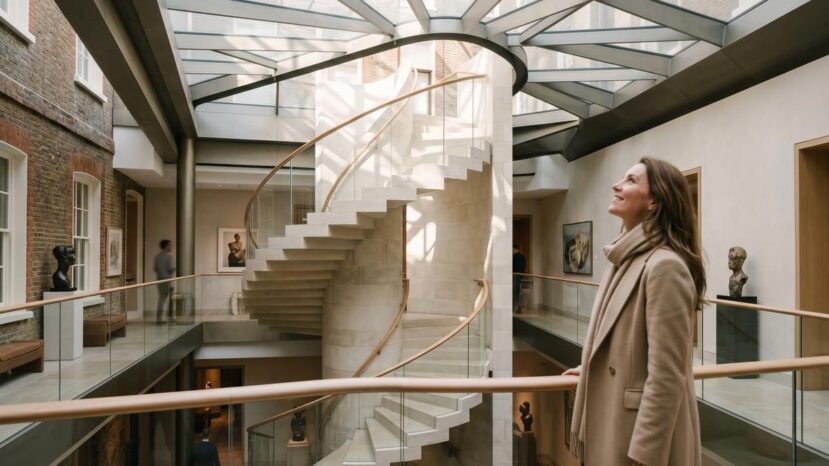
The most striking feature is a restored central atrium, topped by a steel-and-glass canopy designed by Foster + Partners. In the center stands a spiral staircase made of limestone and glass, with a handrail finished in calfskin. Visitors pass beneath a seven-meter-high facade, under a vaulted ceiling that echoes the six arches of the windows. The floor of the entrance features the Faubourg motif with the company’s bookplate inlaid.
- 55 rooms, each with its own distinct character, spread across five floors
- 16 industries represented: leather goods, women’s and men’s ready-to-wear, jewelry, beauty, tableware, equestrian sports
- A central atrium topped by a glass roof designed by Foster + Partners
- A café and private VIP lounges available to guests
- More than 500 works of art selected with the involvement of Pierre-Alexis Dumas
An artistic village, not a shopping mecca
What sets this House apart from other major openings in the global luxury sector is its rejection of commercial spectacle. More than 500 works of art were selected with the involvement of Pierre-Alexis Dumas and are scattered throughout the 55 rooms as if in a private residence. Furthermore, each room has its own character, creating a series of discoveries rather than a parade of collections.
Artisanal details are evident everywhere: woodwork, leather, marble, woven textiles, and glassware. These materials serve as a reminder that the house with the horse logo does not sell products, but rather craftsmanship passed down from generation to generation. As a result, a visit feels more like a tour of a private home than a shopping trip.
The company’s 16 business segments are represented in this space: leather goods, women’s and men’s ready-to-wear, jewelry, beauty, tableware, and equestrian products. There is also a café for visitors, while private VIP lounges are reserved for the company’s most loyal customers.
Business as Usual for London Customers
Maison Bond Street replaces two existing locations: the former store at 155 New Bond Street, which closed two weeks before the opening, and the Selfridges boutique. Customer profiles from both locations were automatically transferred. As a result, no loyal customer will lose touch with the brand.
Hermès now has four locations in London: the Bond Street flagship store, the Sloane Street boutique, the Bluewater boutique, and a location in Edinburgh. This expanded presence creates a cohesive network across London, serving both local and international customers.
An opening that will make its mark on the luxury retail industry in 2026
In an industry where flagship store openings are becoming increasingly common, this one stands out for its long development period and attention to detail. Seventeen years of preparation, six historic buildings assembled in a single location, a glass roof by Foster + Partners, and a staircase with a calfskin-trimmed handrail: every choice reflects a rare level of excellence. Conversely, no concessions were made to speed or passing trends.
The Faubourg House has thus built—both literally and figuratively—much more than just a retail location. The location at 166 New Bond Street, acquired in 2009, has become the symbol of a vision of luxury that values permanence over the ephemeral. As a result, Maison Bond Street has established itself, since its opening, as one of the leading names in high-end retail in Europe.
For lovers of craftsmanship and architecture, Maison Bond Street offers a rare experience: the chance to wander through 55 rooms brimming with art and fine materials, in the heart of an 18th-century Georgian building reimagined for the 21st century. By its very existence, it poses a simple question to other players in the global luxury industry: How long are you willing to wait to do things right?