
Rolex, Patek Philippe, Cartier: The 9 Most Beautiful Platinum Watches to Spot at a Glance in 2026
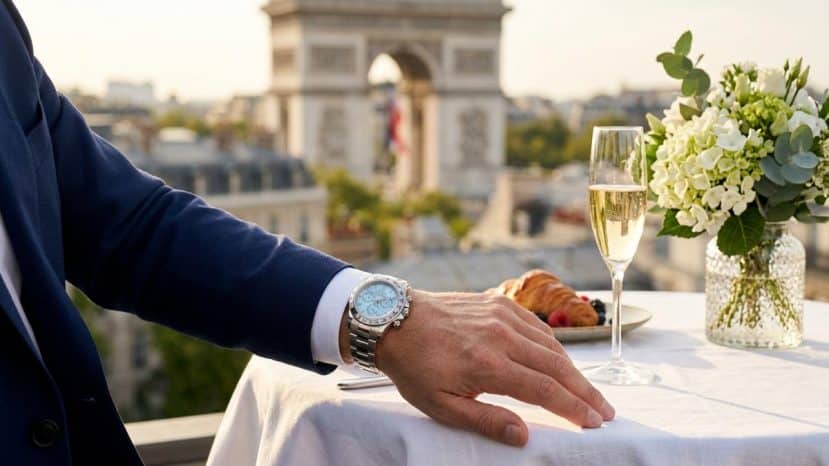


Platinum is fascinating, yet it can be misleading. On the wrist, a platinum watch looks almost identical to a model made of steel, white gold, or rose gold. However, the price, the weight, and the subtle details hidden by each manufacturer tell a completely different story.
What Platinum Really Says About Itself
Platinum is a denser metal than gold. It therefore feels heavier in the hand, which is often the first clue. However, some jewelers have ingeniously solved this problem.
Audemars Piguet, for example, incorporated titanium into the case of its Royal Oak Perpetual Calendar Automatic Ultra-Thin (RD#2) to make the watch lighter overall. The result: a 41-mm case made of 950 platinum that is just 6.3 mm thick, housing a movement that measures 2.89 mm. To date, this is one of the most elegant solutions to the problem of weight in platinum watches.
For its part, Omega opted for the most straightforward approach: engraving the code “PT950” on the back lug of its Speedmaster Caliber 321—that is, the part of the case that connects the bracelet to the middle case. To see it, all you have to do is turn the watch over. However, the listed price — 113,000 euros —has probably already put you on the right track.
The distinctive features chosen by each brand
Each manufacturer has developed its own visual code to indicate that a piece is made of platinum. These clues are subtle, sometimes trivial, but always rich in meaning for those who know how to read them.
“Watch collectors love the little details and the stories behind them.”
This is according to Karl-Fritz Scheufele, son of Chopard’s owner and the driving force behind the launch of the platinum Alpine Eagle. The Swiss brand has thus engraved a bee in the lower left corner of the case of its Alpine Eagle 41 XP CS in platinum, which retails for 119,000 euros. This insect, revered by founder Louis-Ulysse Chopard, serves as a discreet marker to distinguish this metal from others.
At Cartier, it’s the Santos-Dumont (22,800 euros) that features the coded signature. The Breguet-style hands and the red cabochon immediately signal that the watch is made of platinum. Furthermore, the number 7 displays the year “1903” in place of the name “Cartier,” commemorating the date on which Brazilian aviator Santos-Dumont landed in front of his apartment on the Champs-Élysées.
Louis Vuitton, for its part, has set a 1.6-mm saffron-colored sapphire on the back of the 40-mm case of its Tambour, which retails for approximately 150,000 euros. The color of this sapphire echoes the French fashion house’s highly recognizable hue. It’s understated, precise, and effective.
- Audemars Piguet: titanium added for a lighter weight, satin-finished blue dial with white gold hands
- Chopard: bee engraved on the lower left side of the case
- Cartier: Breguet hands and a red cabochon on the Santos-Dumont
- Omega: “PT950” engraved on the rear lug
- Louis Vuitton: 1.6 mm saffron-colored sapphire set into the back of the case
- Rolex: Glacier Blue Dial Exclusive to All Platinum Models
Rolex, finally, has adopted a clear, brand-wide rule: all of its platinum watches feature a glacier-blue dial. This is true of the new Land-Dweller, priced at 66,900 euros, as well as the Daytona, the Day-Date, and the Perpetual 1908. It’s a simple color scheme that leaves no room for doubt.
Complications: The Key Selling Point of High-End Platinum
When platinum is chosen for a watch case, it is rarely by chance. This metal is generally paired with exceptional movements, as it justifies a place at the top of the line.
The Vacheron Constantin Traditionnelle Twin Beat Perpetual Calendar, launched in 2019, is a good example of this. Its 42-mm platinum case, featuring a fluted caseback and a thickness of 12.3 mm, houses a sapphire dial divided into two distinct sections. This perpetual calendar displays the month, date, day, and week. Price upon request.
Jaeger-LeCoultre takes things even further with its Master Grande Tradition Caliber 985, released in 2025. On its sunburst blue dial, a tourbillon weighing just 0.4 grams shares the stage with a three-counter perpetual calendar: the month and year at 12 o’clock, the day of the week at 3 o’clock, and the date at 9 o’clock. The Caliber 985 was designed, assembled, and decorated in the Joux Valley. Price upon request.
Patek Philippe, for its part, has opted for a more everyday-oriented approach with the Calatrava 6196P-001, priced at 48,700 euros. The platinum version features a small diamond set at the 6 o’clock position on the bezel. The leather strap gives the watch a lighter feel, unlike watches made entirely of this metal. Platinum is cheaper per ounce than gold—about 1,950 euros versus 3,980 euros —but its higher density more than makes up for the price difference in terms of how it feels on the wrist.
Why Platinum Remains the Most Difficult Metal to Identify
Platinum has no distinctive color that gives it away. It resembles steel, white gold, or gray gold. It is therefore through the specific codes used by each manufacturer that the discerning collector learns to recognize it.
Thus, the design elements are sometimes narrative, as with Chopard; sometimes purely functional, as with Omega; and sometimes chromatic, as with Rolex. In all cases, they require familiarity with each brand’s product lineup and history. This is precisely what makes platinum watches objects for connoisseurs, far beyond their status as mere precious metals.
Now that you have these points of reference, you can look at a wrist in a whole new light. An engraved bee, a glacier-blue dial, a red cabochon, or a few letters inscribed on the back lug: these tiny details are, in fact, platinum’s most discreet and authentic signature in watchmaking.