
No more underarm sweat patches this heatwave: this €10 roll-on lasts 72 hours


Every summer, the same damp stains appear under the arms and betray underarm sweat patches on light-coloured clothing, turning even the shortest journey into a source of anxiety. When a heatwave sets in, the problem intensifies and the usual solutions no longer cut it. Understanding why heat makes things worse is the first step to finding the right fix.
Why heat makes underarm sweat patches worse
Sweating is, first and foremost, a useful mechanism: the body produces sweat to regulate its temperature and flush out toxins. On average, we generate one litre of sweat per day, but that volume can climb to ten litres during intense exercise, extreme heat or in cases of hyperhidrosis. When temperatures soar, that output explodes and underarm sweat patches become almost unavoidable.
Yet sweat itself is not the problem when it comes to odour. Juliette Lailler, co-founder of Krème, puts it plainly: two bacteria present under the arms break down the fatty compounds in sweat and convert them into the components responsible for bad smells. During a heatwave, the heat and humidity feed these bacteria, making odours more persistent even after a shower.
The skin under the arms also has its own particular characteristics. Marie Drago, doctor of pharmacy and founder of Gallinée, points out that this area is more humid, darker, and has a pH of around 6.5, less acidic than the rest of the skin. That is precisely the pH level at which odour-producing bacteria thrive best. This environment becomes even more active the moment outdoor temperatures rise.
Deodorant, antiperspirant, clinical-strength antiperspirant: very different actions
Not all products are equal when it comes to tackling underarm sweat patches. A standard deodorant works mainly on odour and absorbs some moisture, without blocking the flow of sweat. An antiperspirant goes further: the aluminium salts it contains bind with sweat proteins and temporarily block the pores of the sweat glands, reducing the flow.
Clinical-strength antiperspirants, based on aluminium chloride hexahydrate, form an even longer-lasting plug, effective for two to five days, for the most pronounced cases of hyperhidrosis. The safety of aluminium salts has been questioned, but the European Scientific Committee on Consumer Safety published a report in 2020 confirming their very low absorption through the skin, even on shaved or waxed skin, with no demonstrated toxicity at standard doses.
What the Dermafresh Ipersudor roll-on offers against stains and hyperhidrosis
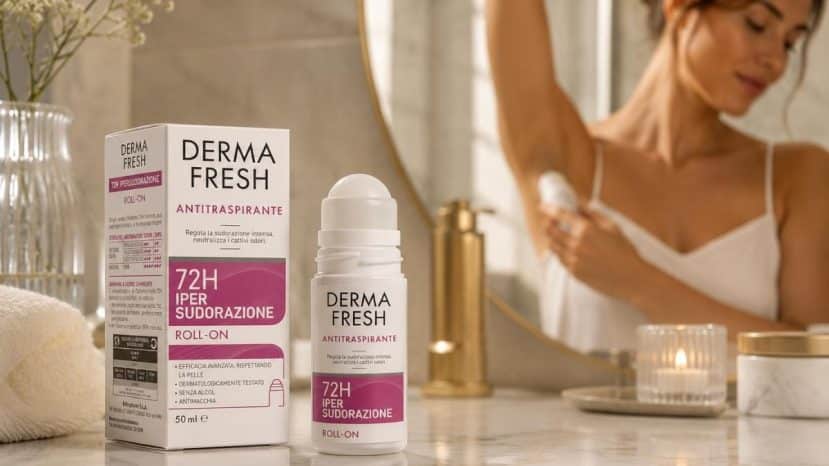
Designed specifically for hyperhidrosis, the Dermafresh Ipersudor roll-on acts on the sweat glands to regulate perspiration. It protects and hydrates the skin, leaves a subtle fragrance and promises up to 72 hours of efficacy. Its formula is dermatologically tested, alcohol-free, and leaves no marks on clothing, which directly reduces the risk of underarm sweat patches on light fabrics. It retails for around €10.62 online.
To get the most out of it, the ideal time to apply is in the evening, on skin that is clean, completely dry and free of irritation. This allows the active ingredients to bond properly within the sweat ducts. What’s more, these formulas are not entirely washed away in the shower: applying it every other day is often enough to keep hyperhidrosis under control. For reactive skin, spacing out applications further reduces friction and therefore redness.
Natural alternatives to limit underarm sweat patches
For those who prefer to avoid aluminium salts, other ingredients are available. The Yuka app can help identify deodorants formulated with triethyl citrate, zinc derivatives or prebiotics. These options handle odour well, but are less effective at curbing heavy sweating than a powerful antiperspirant.
- Baking soda absorbs moisture and slows the proliferation of odour-causing bacteria, according to Angèle Labbé, head of formulation at Endro.
- It can, however, irritate the skin and cause superficial hyperpigmentation of the underarms due to repeated friction.
- Magnesium hydroxide replaces it in versions for sensitive skin: both antibacterial and anti-inflammatory, it regulates pH and absorbs up to twice its weight in water.
- Natural sticks now benefit from balm textures that glide on easily without melting, thanks to improved hot-pour techniques.
If you react to an antiperspirant, the approach is straightforward: stop for a few days, moisturise the area, then gradually reintroduce it or switch to an alcohol-free formula. If the irritation persists, medical advice is the way to go. Because tackling underarm sweat patches during a heatwave ultimately comes down to finding a product suited to your skin type and your level of perspiration.