Beckham, Ronaldo, Styles: the men who can’t get enough of Pilates
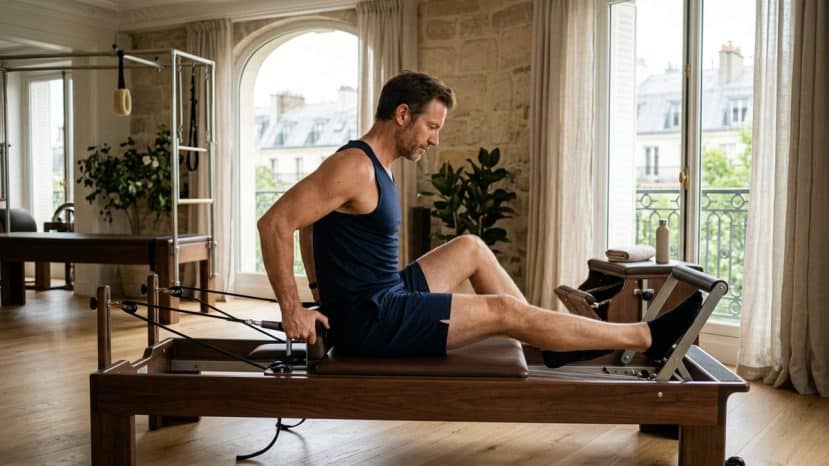


Picture David Beckham dedicating an hour a day to a practice long associated with pastel-hued studios and women-only classes. This is no isolated anecdote: Pilates is undergoing a profound shift, driven by men who have made it a cornerstone of their training, and by professionals who are quick to point out that the method was never designed for one gender alone.
A method born for men, rediscovered by them
The story of Pilates begins far from any trendy studio. Its founder, Joseph Pilates, was passionate about gymnastics, yoga, martial arts and boxing. During the First World War, he developed a rehabilitation method aimed at men. It was only later, after encountering dancers from the New York City Ballet, that he adapted his practice to work on coordination, movement control, postural precision and the mind-body connection.
Sergi Amoros, a former professional dancer who is opening his own studio, Studio Villiers Pilates, at the end of August, recalls this often-forgotten origin. After 12 years with choreographer Angelin Prejlocaj’s company, it was an injury that led him to the method. He describes it as a revelation: depressed at no longer being able to dance, he found in it a tool for recentring, deep strengthening and alignment. From then on, at every world tour stop, he would seek out a class before taking the stage, seeing the practice as a personal space in which to protect his body.
What Pilates concretely offers male athletes
For men who train intensively, the benefits Sergi Amoros observes in the athletes he works with are specific. He notes in them a sharper awareness of their movements, greater gestural efficiency, improved breathing and heightened concentration. These gains do not replace strength training, they complement it.
- Strengthening of deep muscles, often neglected in the gym
- Improved flexibility and balance
- Reduced risk of injury
- Better breath control during physical effort
- Enhanced concentration and movement control
In France, the method is still widely perceived as being reserved for women. Yet this perception reflects neither the discipline’s history nor its real effects. Amoros is insistent: the practice is not gendered in any way, and its complementarity with more physically demanding training makes it an asset for any athlete looking to progress sustainably.
The male celebrities normalising the practice
In the public eye, several male figures are helping to change the way this method is perceived. Harry Styles, Cristiano Ronaldo and Justin Bieber now openly claim Pilates as an integral part of their training. David Beckham, for his part, took it up in the late 2000s and says he practises for an hour every day.
On TikTok, the hashtags #PilatesBoys and #MenDoingPilates bring together men from all walks of professional life documenting their sessions. This digital movement reflects a deeper trend: the method is gradually breaking free of the box it had been placed in.
On ClassPass, meanwhile, Pilates has been the most-booked class in the world since 2023, a title it has held year after year. That figure speaks to a popularity that goes well beyond a passing trend.
The studio aiming to reconnect with the original method
Studio Villiers Pilates, which will open on 24 August alongside former dancer Béatrice Laurent, intends to go beyond the Reformer, the piece of equipment best known to the general public. The goal is to reintroduce the Wall Unit, also known as the tower, along with the method’s other historic apparatus, in order to engage the body as a whole.
This approach rests on a philosophy that places concentration at the heart of the practice. Amoros describes this dimension as genuinely spiritual: focusing the mind, setting aside the stress of the day, reconnecting with oneself. Far from a simple muscle-strengthening class, this vision of Pilates offers a different way of inhabiting one’s body, one where performance is as much about listening to yourself as it is about pushing your physical limits.