This Pyrenean village hidden in the UNESCO list has two cathedrals and a Romanesque cloister
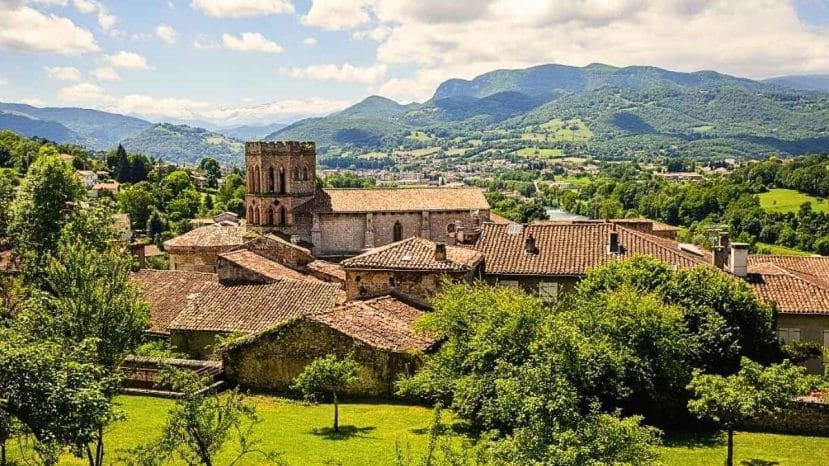


Picture cobblestone lanes, half-timbered houses and two cathedrals standing side by side in a single small town: that is exactly what Saint-Lizier has to offer, a village in the Pyrenees located about a hundred kilometres south of Toulouse. This medieval settlement, awarded the Petite Cité de Caractère label, holds a remarkably rare heritage that most visitors never suspect exists.
A medieval heritage at the heart of this Pyrenean village
From the moment you arrive, the ancient ramparts encircling Saint-Lizier set the scene. The Clock Tower and the half-timbered houses lining the narrow streets carry visitors into a world from another era. This well-preserved setting is no accident: the town was for a long time an episcopal city, which explains the density and quality of its monuments.
At the top of the village, the Palais des Évêques stands as a testament to that long religious history. Between the 5th century and 1801, no fewer than 77 bishops held office here. The building now houses the Ariège departmental museum, which traces the history of the département from Antiquity to the present day. The palace is also listed as a UNESCO World Heritage Site, a distinction that underlines its significance on an international scale.
Two cathedrals and a Romanesque cloister not to be missed
What truly sets Saint-Lizier apart from other Pyrenean villages is the presence of two cathedrals within such a compact space. The first, Notre-Dame-de-la-Sède, sits within the inner courtyard of the Palais des Évêques. It is celebrated for its Renaissance-style paintings, which adorn its walls with remarkable refinement.
The second cathedral, dedicated to Saint Lizier himself, occupies the main square of the village. It houses Romanesque frescoes dating from the 12th century, among the most precious in the region. Both buildings, inscribed on the UNESCO World Heritage List, together form an architectural ensemble unique in France.
Nearby, the Romanesque cloister built in the 12th century deserves a long, unhurried visit. Its 32 arcades, carried by single and double columns, create a space of quiet, understated elegance. It is one of the best-preserved examples of Romanesque architecture in the Ariège Pyrenees.
- The Palais des Évêques, seat of 77 bishops from the 5th century to 1801
- The cathedral of Notre-Dame-de-la-Sède and its Renaissance paintings
- The cathedral of Saint-Lizier and its 12th-century Romanesque frescoes
- The Romanesque cloister with 32 arcades, built in the 12th century
- The pharmacy of the Hôtel-Dieu, founded in the 18th century
An 18th-century pharmacy frozen in time
Among the village’s lesser-known curiosities, the pharmacy of the Hôtel-Dieu deserves special attention. Founded in the 18th century, it has kept its original wooden shelves, still lined with old potions, ancient syrups and remedies from a bygone age. In 2026, this space remains a striking record of past medical practices, open to visitors with a curiosity for history.
Saint-Lizier, a stop on the Camino de Santiago routes through the Pyrenees
Beyond its built heritage, this Pyrenean village is woven into a long tradition of passage and pilgrimage. Saint-Lizier is a staging post on the Chemins du Piémont along the GR78, recognised as part of the routes to Santiago de Compostela. This pilgrimage dimension lends the town a particular aura, that of a place of passage charged with meaning for centuries.
The commune also serves as a starting point for several hiking trails, including the chemin de Gabats and the path leading to the chapelle du Marsan. Walkers will therefore find a natural playground here, perfectly complementing the cultural visits. This Pyrenean village brings together, in a single place, listed heritage, spirituality and nature accessible on foot.
For visitors planning their stay, Saint-Lizier lends itself to a full day of discovery: combine a morning visit to the palace and its two cathedrals, a midday pause at the cloister, then a detour through the historic pharmacy before heading out onto the surrounding trails.