“I’ve never worn jeans in my life”: Miuccia Prada’s confession before reinventing the iconic piece


When two of today’s most influential designers admit they almost never wear jeans, and then present an entire collection built around that garment, something unusual is in the works. Prada unveiled its Spring/Summer 2027 collection during Milan Men’s Fashion Week, and the result redefines everything we thought we knew about a garment that’s been around for over 150 years.
An unexpected starting point: jeans reimagined from top to bottom
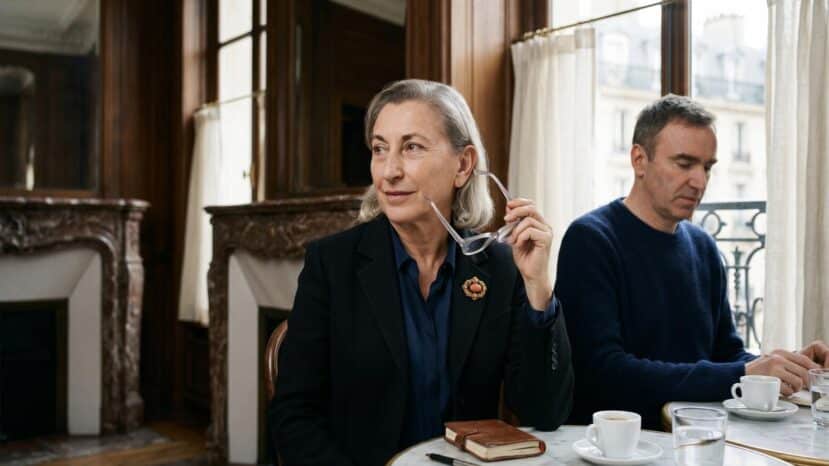
Before the show, Miuccia Prada stated bluntly: “I’ve never worn jeans in my life. ” Raf Simons, for his part, admitted he hadn’t worn any in about twenty years. Yet it is precisely this iconic garment that they chose as the starting point for their collection. This deliberate contradiction sets the tone for a project conceived as a break with convention.
The jeans featured on the runway echoed the iconic five-pocket design reinforced with rivets, invented by Levi Strauss and Jacob Davis in 1873. However, none of them were made of indigo denim. Instead, Miuccia and Raf Simons presented them in shades of raspberry, pink, brown, white, or yellow, sometimes featuring geometric patterns that straddled the worlds of Gio Ponti and the Italian fashion house’s instantly recognizable aesthetic.
The same formal vocabulary was evident in leather pants, cut in a slim, slightly rebellious silhouette, as well as in tailored fabrics ranging from houndstooth to Prince of Wales check. Thus, while the shape remained faithful to the archetype, the materials and colors radically shifted the garment’s meaning.
“We instinctively felt the need to rediscover clarity and focus. That led us to start with clothes that don’t really belong to any particular era—clothes that stand the test of time, that are part of history, and that people always want to wear. The question then was how to reinvent them.” — Raf Simons
Nylon Organza or Architecture Stripped Bare
Of all the materials explored, it was the nylon organza versions that best captured the spirit of the collection. These translucent pants revealed their entire internal structure, exposing the garment’s architecture like a building with its mechanical workings left exposed—a vision that, in some ways, was reminiscent of the Centre Pompidou.
Paired with jackets inspired by the Type III denim cut, these pieces embodied what Raf Simons described as “an anti-spirit”: not a rejection of clothing, but a rejection of unnecessary ornamentation. Furthermore, the asymmetrical glasses worn by the models served as a visual metaphor for this approach, suggesting a different way of looking at what is familiar to us.
- Five-pocket jeans available in raspberry, pink, brown, white, and yellow—never in indigo
- Sheer nylon organza pants that reveal their internal structure
- Geometric patterns inspired by Gio Ponti on select printed designs
- Jackets inspired by the Type III denim cut, paired with silhouettes
- Asymmetrical glasses as the collection’s visual signature
The Italian fashion house’s collection, reimagined in terms of its proportions
This reinterpretation wasn’t limited to just jeans. Several archetypes from the brand’s wardrobe were reimagined through new materials and contexts. Claudine-collar coats, patterned sleeveless sweaters, and V-necks made a comeback with subtly shifted proportions. Some necklines plunged almost to the navel.
Single-breasted tailored jackets with broad shoulders also emerged as fundamental silhouettes, stripped of any superfluous details. For its part, the men’s show featured several feminine silhouettes—a presence that had become rare since the 2019 “Frankenstein” show, which marked the end of the merger of the pre-collections.
Accessories also contributed to this sense of newfound freedom. Miniature versions of iconic bags were suspended from belt loops by carabiners, paired with wide, weathered leather belts. This detail gave the silhouettes a more spontaneous, less constrained look.
A collection designed for the street, not the runway
According to Miuccia Prada, the collection was designed to give wearers room to make it their own and reinterpret it in their daily lives. Raf Simons echoed this sentiment, expressing regret that fashion now focuses more on spectacular runway shows than on clothes that are actually worn.
He maintained, however, that it is possible to express true individuality through simple clothing, provided one thinks carefully about how to put the pieces together. In his view, the most significant developments in fashion also emerge from the streets, from creative individuals, and not just from major fashion houses.
An aversion to ornamentation elevated to the level of an obsession
In the show notes, Miuccia stated: “Right now, nothing irritates me more than ornamentation—unnecessary design elements.” During the interview leading up to the show, she went further, describing this aversion as an “obsession.” For her, ornamentation can only exist if it conveys an idea, whether it criticizes or celebrates wealth—otherwise, it has no reason to exist.
Raf Simons concluded this thought with a straightforward statement: “If we’re completely honest, we both instinctively felt that this collection was born out of everything we no longer want to see today. ” This statement sums up the central theme of the entire fashion show: not fashion that seeks to impress, but fashion that seeks to convey meaning.
As a result, Prada’s Spring/Summer 2027 collection stands out in 2026 as one of the season’s most cohesive offerings. It poses a simple yet radical question: Can we start from scratch—with a garment that everyone thinks they know—to reinvent everything?