
In Brittany, this hilltop of 200 granite giants watches over the Côtes-d’Armor
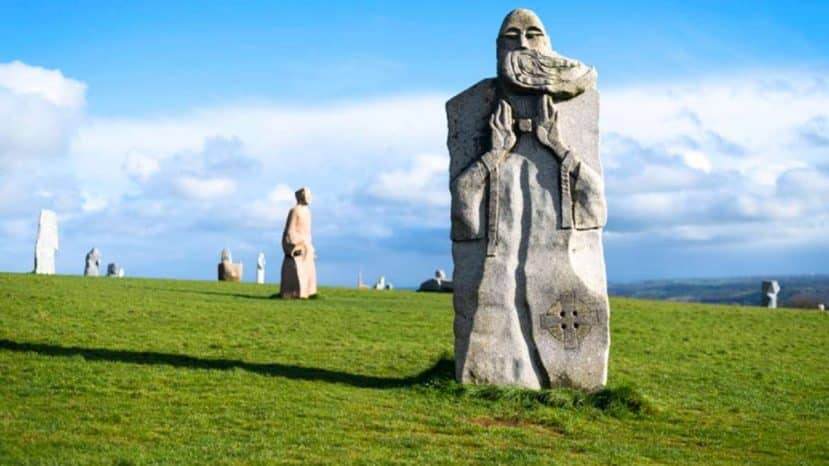


Picture stone silhouettes as tall as houses, standing defiantly against the Breton wind, as though they have been guarding a plateau for centuries. This spectacle is very real, not on a French island, but in the heart of the Côtes-d’Armor, on the heights of Carnoët. La Vallée des Saints is one of the most ambitious artistic projects in the region, and it is well worth the journey.
A plateau at nearly 250 metres, giants that defy time
Perched at nearly 250 metres above sea level, the hill of Carnoët offers sweeping views over the Monts d’Arrée and the Poher. This natural setting is far more than a backdrop: it lends the sculptures an almost supernatural presence. Some of them stand over 7 metres tall, carved directly from solid blocks of granite.
The Breton light, ever-shifting with the hours and the seasons, plays a role all its own in the experience. It draws unexpected reflections from the stone, making every visit feel like a different encounter. The peaceful atmosphere of the place invites you to slow down, far from the bustle of the beaches and the well-worn tourist trail.
The site offers a genuinely original alternative for those who want to venture beyond the coastline while staying in the Côtes-d’Armor. Unlike a French island surrounded by water, this continental plateau offers full immersion in Celtic legend and Breton heritage.
A thousand sculptures over a century: the audacious ambition of a living construction site
The project launched in 2008 with a clear and vertiginous goal: to install 1,000 stone sculptures over a period of one hundred years, running through to 2108. Today, more than 200 colossal works are already in place on the plateau. That figure speaks to the scale of what has been achieved, and to how much still remains to be built.
Each statue represents a Breton saint, and each sculptor brings their own style to the work they create. There is no visual uniformity here: from one figure to the next, the craftsmanship shifts, the treatment of the granite differs, and the gaze of each saint takes on its own singular expression. This artistic diversity makes the walk all the richer.
During the warmer months, visitors can watch artists at work on site. The sound of chisels striking stone and the fine granite dust hanging in the air give the visit a vivid, tangible dimension. You are not simply contemplating a finished result, you are witnessing a work being born.
What the site has in store for visitors
- A free-roaming trail through more than 200 monumental sculptures
- Works reaching over 7 metres in height, carved from Breton granite
- The Chapelle Saint-Gildas, listed as a historic monument, at the summit of the hill
- The chance to watch sculptors working in real time during the warmer months
- Hiking trails in the surrounding area to extend the day
The Chapelle Saint-Gildas deserves particular attention. Listed as a historic monument, it stands proudly on the hilltop and fits naturally into the site as a whole. Its presence is a reminder that this place has a history stretching far beyond the contemporary art project.
Extending the visit into the Poher and the surrounding villages
La Vallée des Saints does not end at the edges of the plateau. The hiking trails that set off from the site allow you to explore the landscapes of the Poher on foot, at your own pace. It is a way of prolonging the experience without leaving the distinctive atmosphere of this corner of the Côtes-d’Armor.
The nearby villages offer welcoming stops for food and drink to round off the day. After a walk among the granite giants, a pause in one of these villages provides a pleasing contrast between the monumental scale of the sculptures and the human-sized rhythms of local life.
For those weighing up a getaway to a French island against a less-frequented inland destination, this Breton plateau makes a compelling case. It brings together art, history, nature and local gastronomy in a single place, with no ferry crossing required. A French island remains an experience in a class of its own, but La Vallée des Saints proves that the Breton interior has its own treasures to reveal.