Gucci, Miu Miu, Bottega Veneta: why luxury houses are racing to claim tennis


Picture Jannik Sinner walking onto Wimbledon’s Centre Court with a custom monogrammed Gucci bag slung over his shoulder: an unprecedented scene in the history of tennis, and one that perfectly captures why luxury houses are turning to the sport in droves. This phenomenon goes far beyond a stylistic footnote. It reflects a deep alliance, built over decades, between two worlds that share the same codes of elegance and exclusivity.
A historic playing field for the great fashion houses
The connection between tennis and luxury houses is nothing new. As far back as the 1920s, Jean Patou was dressing women’s tennis star Suzanne Lenglen in white pleated skirts that fell just below the knee. That founding gesture already laid the groundwork for a lasting relationship between haute couture and the court.
Rolex, for its part, has been the official timekeeper of Wimbledon since 1978. And for more than 20 years, Ralph Lauren has dressed the chair umpires, line judges and ball boys and girls at the US Open. These long-standing partnerships speak to how tennis carries a chic, timeless image that is particularly appealing to players in the luxury space.
As Alan Sweet, a former Gucci buyer, tennis coach and Los Angeles-based content creator, explains, this connection has always existed. What has changed today is the scale of the visibility, massively amplified by social media.
Why luxury houses are betting on the circuit’s biggest stars
Tennis has a rare quality among elite sports: it is an individual discipline. In any given match, a player can spend several hours on court, filmed in close-up, in front of millions of viewers. Over two weeks of a Grand Slam tournament, that exposure becomes enormous. For luxury houses, it is an unrivalled showcase.
Jannik Sinner, the world number one in men’s tennis, continues his collaboration with Gucci as a brand ambassador. Lorenzo Musetti, whose look is closer to a runway model than a tennis player, has been a Bottega Veneta ambassador since last year. In early 2026, Aryna Sabalenka, the world number one women’s player at 28 years old, will join Gucci as an ambassador in turn.
On the women’s side, Coco Gauff, the highest-paid female athlete in the world, is the face of the partnership between Miu Miu and New Balance. The resulting collection includes tennis skirts, tops and trainers. These collaborations are not simply image deals: they produce real pieces, worn both on and off the court.
Outfits that break the rules, from Serena Williams to Naomi Osaka
Players have never waited for luxury houses to shake up tennis’s dress conventions. In 1985, American player Anne White stepped onto the Wimbledon court in a form-fitting long-sleeved catsuit. In the late 1980s, André Agassi played in denim shorts. And in the early 2000s, Serena Williams wore a denim skirt with knee-high black boot covers at the US Open.
Years later, Serena Williams dazzled in an asymmetric dress inspired by dance and ballet, created for Nike by Virgil Abloh. These bold style choices paved the way for an increasingly confident personal expression on the court.
Naomi Osaka takes this logic even further. The Japanese player turns her arrivals at Grand Slam tournaments into full-blown fashion moments. Last May at Roland-Garros, she wore a Swarovski crystal-encrusted bustier and a long tulle skirt, designed by Kevin Germanier, a Swiss designer specialising in upcycling. Her outfits project a strong identity, and that is precisely what luxury houses look for in their ambassadors.
Tenniscore: when a sport becomes a lifestyle aesthetic
Tennis has now permeated pop culture well beyond the court. In 2024, Luca Guadagnino’s film Challengers, starring Zendaya with costumes by Jonathan Anderson, elevated the sport’s glamorous image to a new level. The film fuelled a wave of posts on social media under the hashtag #tenniscore.
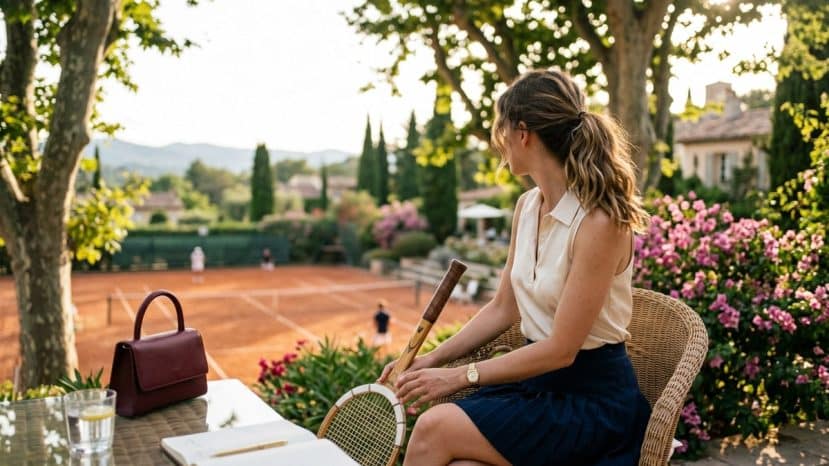
Under that hashtag, a fully formed aesthetic has taken hold: mini skirts, pleated dresses, polo shirts and images of courts overlooking the Mediterranean have become the symbols of an aspirational lifestyle. Whether or not you actually play tennis, this aesthetic has captured an entire generation.
- Jean Patou dressed Suzanne Lenglen as early as the 1920s
- Rolex, official timekeeper of Wimbledon since 1978
- Ralph Lauren has supplied the official uniforms for the US Open for more than 20 years
- Coco Gauff, Jannik Sinner, Lorenzo Musetti and Aryna Sabalenka: four circuit stars tied to luxury houses
- The film Challengers (2024) and the hashtag #tenniscore have amplified tennis’s glamorous aura
For luxury houses, tennis combines several rare assets: a chic and timeless image, prolonged individual visibility on the court, and now a strong presence in pop culture. The US Open, held each late August at Flushing Meadows Park in New York, gives these brands a global stage on which to assert their style ambitions, match after match.