Hairdressers are backing this 90s blowout that’s a game-changer for fine hair
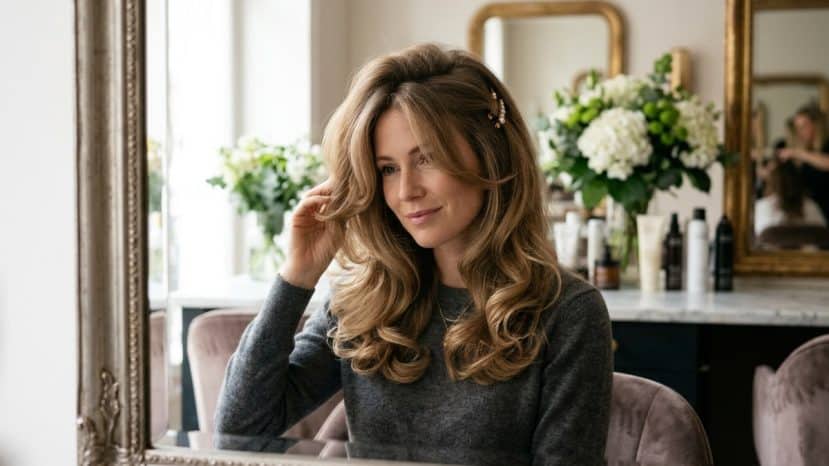


If you have fine hair and you’re looking for a style that finally gives it some body, hairdressers are unanimous: the voluminous 90s blowout is back, and it answers that need precisely. Far from the ultra-straight blowdry that dominated salons for so long, this technique brings back hair that’s soft, glossy and full of movement.
What hairdressers are seeing come back into salons in 2026
The hair landscape is clearly shifting. Professionals in the industry are observing a gradual move toward more natural, less rigid finishes. Hairdresser María Roberts confirms it: layers are making a comeback, along with ends styled inward or outward, and a polished finish is taking over from perfectly straight hair.
Miguel Bling, hairdresser, make-up artist and director of You Glow salon in Madrid, describes this aesthetic as natural glamour: soft waves, lifted roots and a luminous finish, all achieved with a hairdryer and a round brush. The result is immediately striking, hair looks denser, gains lightness, and the style holds that impeccable allure that made the great icons of the decade so memorable.
Names like Cindy Crawford and Claudia Schiffer perfectly embody this ideal: voluminous, shiny and soft hair that never looks overdone. María Baras also points out that the tools of the era were different, rollers, hairdryers and hands replaced curling irons, for a more spontaneous result.
Why the cut is the real starting point
Before you even pick up a round brush, the cut is what determines everything. Without layers, María Roberts is clear on this, it’s much harder to achieve that soft, fluid hair that’s so characteristic of the 90s. Different lengths create texture and allow volume to be distributed more evenly, whereas a uniform mass gives the impression of flat hair.
Two cuts keep coming up in current inspiration boards, according to experts: the butterfly cut and the shag cut. Both options are particularly well-suited to a voluminous blowout, as they naturally encourage movement through the lengths. The butterfly cut has an added advantage: it can dry almost naturally while still holding its movement, which significantly cuts down on styling time.
The key points for adapting this blowout to your hair type
- For fine hair: layers add lightness and working the roots creates instant lift.
- For thick or curly hair: the right cut and degree of layering can achieve a similar result.
- For a more polished effect: spend more time working the ends with the round brush.
- For a relaxed version: keep the movement softer and less defined.
- To save time: go for the butterfly cut, which dries almost naturally.
How hairdressers adapt this blowout to suit different preferences
One of the biggest strengths of this technique is its versatility. Specialists point out that the result can vary depending on the level of finish you’re after. A very thorough round-brush blowout will give a sophisticated, structured look. A quicker, less precise pass, on the other hand, produces a natural and relaxed effect without sacrificing volume.
This flexibility is part of why hairdressers recommend this method to such a wide range of clients. Because while the voluminous blowout is particularly flattering for fine hair, it isn’t reserved for it alone. With a well-thought-out cut, thick or curly hair can also benefit from this signature movement, as long as the degree of layering and the intensity of the brush work are adjusted accordingly.
Ultimately, the return of the 90s blowout reflects a deeper shift in hair trends: professionals now favour movement, texture and shine over the rigidity of a straight blowdry. A shift that fine hair, so often in search of volume, has every reason to embrace.