She turned her private collection into an online makeup museum with 1,500 cult pieces
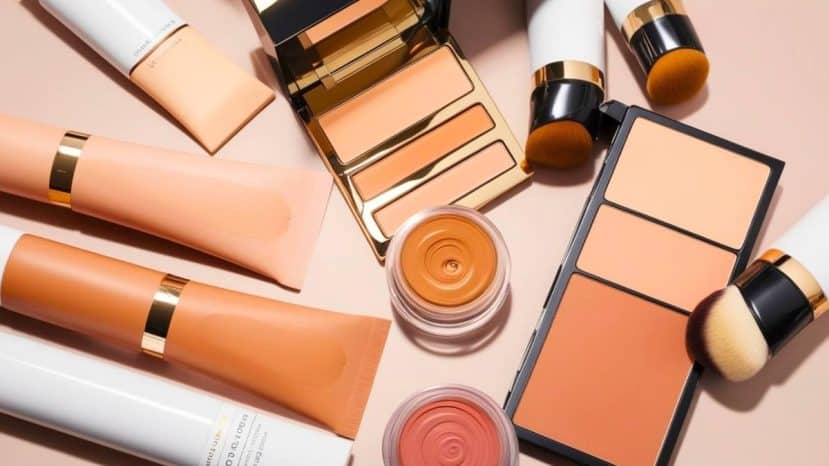


What if a lipstick tube could tell the story of Hollywood, of women, and of an entire era’s beauty standards? That’s exactly the premise behind Erin Parsons’s online makeup museum, The Makeup Archive, launched last August and already home to more than 1,500 rare and vintage pieces.
A makeup artist turned guardian of cosmetic history
Before becoming Global Makeup Artist for Maybelline or working alongside Pat McGrath, Erin Parsons spent ten years in retail, including a stint at M.A.C., before moving to New York at 28. A fascination with the transformative power of makeup has driven her since adolescence. She describes first discovering Marilyn Monroe, then wanting to understand what came before her, before Norma Jean. That interest in metamorphosis has shaped her entire career.
Among her greatest influences is Kevyn Aucoin, whose books, particularly Making Faces, published in 1997, taught her to look at the face differently. Aucoin helped elevate makeup into a discipline to be understood and passed on, far beyond a mere succession of trends. Parsons continues that legacy today, but with the objects themselves as her raw material.
What this digital makeup museum contains
The collection Erin Parsons has been building for around a decade spans a remarkable range. It includes Art Deco powder compacts, lipsticks, false lashes, and cosmetics dating back to the early decades of the twentieth century, as well as pieces connected to Hollywood icons such as Marilyn Monroe, Mae West, and Elizabeth Taylor. Among the documented treasures are also formulas and archival materials related to Kevyn Aucoin.
- More than 1,500 rare and vintage pieces gathered over a decade
- A documentation process spanning more than three years, carried out with archivist Holly McGraw
- Objects connected to Marilyn Monroe, Mae West, and Elizabeth Taylor
- Formulas and archives related to Kevyn Aucoin
- A first digital exhibition, The Beauty of Archive, photographed by Vanessa Granda and directed by Mat Cullen
Every piece is photographed, documented, and placed in context. This work was carried out over more than three years with archivist Holly McGraw, under the auspices of the MUA Foundation. What sets this approach apart is the attention paid not merely to an object’s rarity, but to the story it can tell: a technique, a beauty ideal, an entire industry.
From perishable product to cultural artefact
Makeup has long been treated as a consumer good, launched one season, forgotten the next. This makeup museum upends that logic. A powder compact is no longer valued solely for what it once contained, but for the silhouette, the decade, or the beauty rituals it allows us to trace. A 1960s Max Factor Hollywood lipstick that belonged to Marilyn Monroe becomes, in this light, a document in its own right.
This heritage-driven approach grants makeup the status of a cultural object worthy of preservation and study. What was once destined to be discarded after use becomes something worth keeping. The MUA Foundation is driving the project with the ambition of making it a definitive reference resource dedicated to the history of beauty.
How to access and support this makeup museum
For now, this makeup museum has no physical address in New York, though the MUA Foundation is working towards a future space in the city. In the meantime, the collection is accessible online, complete with its catalogue entries and its first digital exhibition, The Beauty of Archive. The project doesn’t rely solely on Parsons’s personal collection, either.
The foundation invites the public to contribute through donations, with the goal of gradually building a collection substantial enough to serve as a genuine resource on the history of beauty. The Makeup Archive already has its collections, its labels, and its first exhibition space, even without walls. This makeup museum proves that a lipstick tube can, too, become an object of memory.