Just 2 hours from Paris, this London neighbourhood hosts Europe’s biggest carnival
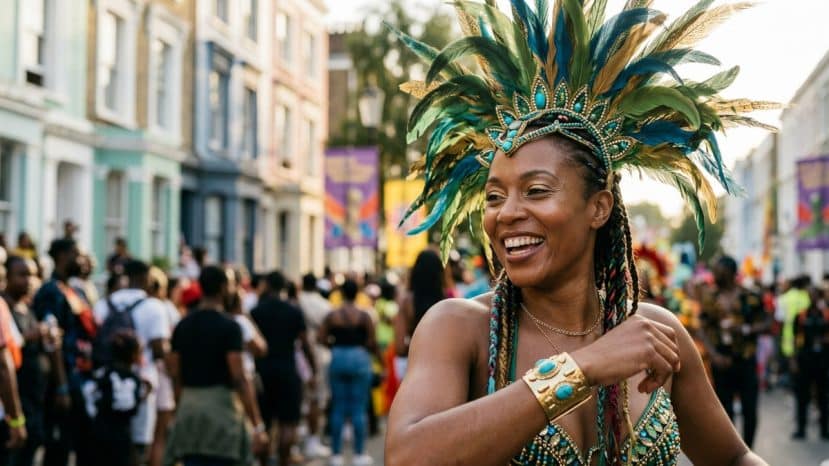


Picture three days of feathered costumes, Caribbean rhythms and spiced street food, just a few hours from Paris. Every year, the London neighbourhood of Notting Hill plays host to Europe’s biggest carnival, an event that goes far beyond a simple street party. From 29 to 31 August, with a bank holiday Monday thrown in, the British capital transforms into one giant open-air stage.
Deep roots in the history of Caribbean communities
To understand what this event truly means, you have to go back to the 1950s. At the time, Notting Hill was a neighbourhood scarred by severe racial tensions, which came to a head during the 1958 riots. A year later, the racist murder of Kelso Cochrane, a young carpenter from Antigua, plunged the community into grief and anger.
It was against this backdrop that activist Claudia Jones made a bold decision: to organise a Caribbean carnival in London. Her aim was twofold, to celebrate the culture of Caribbean communities and to create a moment of unity in a fractured city. That first carnival laid the foundations for what would become Europe’s biggest carnival.
It wasn’t until 1966 that the festivities spilled out onto the streets of Notting Hill. That year, a steel band led by Trinidadian musician Russell Henderson made its way down Portobello Road. That inaugural procession, modest at the time, gradually grew to weave together Trinidadian, Jamaican and broader Caribbean influences, until it became the phenomenon we know today.
What Europe’s biggest carnival has in store for visitors
On the ground, the experience hits you through the ears first. Sound systems pump out reggae, soca, calypso, dancehall and dub throughout the weekend. Cultures collide and intertwine along the streets, offering a sonic journey without ever leaving the European continent.
On Saturday evening, one particular event is worth singling out: the steel pan orchestra competition held at Emslie Horniman’s Pleasance Park. It’s the only ticketed moment of the weekend, but it stands as one of the highlights of this great Caribbean celebration.
For food lovers, the street food stalls are not to be missed. Jerk chicken, roti, Trinidadian dishes, vegetarian and vegan options: the offering is every bit as colourful as the sequinned costumes parading through the streets. Rum punches and infused spirits round out the culinary picture.
How to plan your visit and make the most of this extraordinary event
Attending Europe’s biggest carnival takes a little organisation. Here are the key things to keep in mind before you go:
- Wear comfortable shoes, as the neighbourhood’s streets are largely closed to traffic and you’ll be moving from spot to spot on foot.
- Plan your transport in advance, as several Tube stations can get extremely busy during the event.
- Arrive hungry so you can make the most of the Caribbean street food stalls.
- Set aside Saturday evening for the steel pan competition at Emslie Horniman’s Pleasance Park.
- Choose well-located accommodation to cut down on travel time and maximise your time at the carnival.
On that last point, the easyHotel London Paddington, located at 10 Norfolk Pl, Tyburnia, London W2 1QL, has a real practical advantage. Less than five minutes’ walk from Paddington station, it offers easy access to the airport. From there, Notting Hill and Marylebone are reachable in under 15 minutes on foot, as is Hyde Park.
Notting Hill, far more than a film set
The neighbourhood may owe part of its international fame to the movies, but this carnival gives it an entirely different dimension. Over the decades, this annual gathering has become a cornerstone of London’s identity. It carries within it a story of resistance, cultural pride and togetherness.
In 2026, Europe’s biggest carnival continues to draw visitors from across the continent and beyond. Because beyond the costumes and the rhythms, what unfolds each year in the streets of Notting Hill is a living history lesson. Attending this event is about far more than having a good time: it’s about understanding how a community turned pain into celebration.