Verlaine, Breton, Vuillard: the famous figures buried at the cimetière des Batignolles
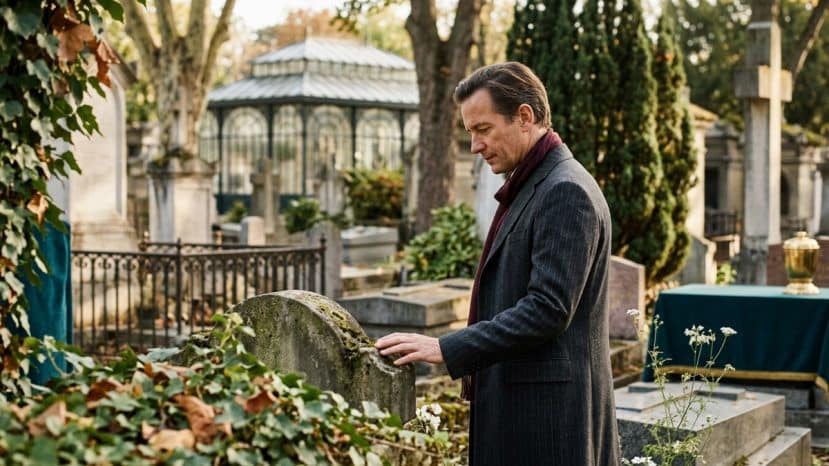


A walk through the cimetière des Batignolles is a walk through literary history, aviation firsts, and the heart of Surrealism, all within a few steps. This quietly remarkable site in the 17th arrondissement of Paris, so often overshadowed by Père-Lachaise or Montparnasse, holds a roster of notable figures that is as dense as it is surprising.
A Parisian cemetery unlike any other
Founded in 1833 to serve the commune of Batignolles-Monceau, the site became part of Paris when that commune was partially annexed in 1860. Today, its roughly 11 hectares contain nearly 15,000 graves, shaded by more than 800 trees. The setting is lush and green, almost unexpectedly so for an urban space of this density.
Since 1969, the cimetière des Batignolles has had a striking architectural peculiarity: the 440-metre viaduct of the boulevard périphérique passes directly over part of the site. This infrastructure has had very real consequences for certain graves. The tomb of Paul Verlaine, originally located in the 20th division, was relocated in 1989 to the 11th division, near the central roundabout, due to the disruption caused by the motorway overhead.
Surrealists, painters and poets: the great figures of the cimetière des Batignolles
Verlaine rests in the family vault alongside his parents and his son Georges. His body of work, which includes the Poèmes saturniens and the Fêtes galantes, makes him one of the defining voices of 19th-century French literature. His presence here alone is reason enough to visit.
Nearby, in the 31st division, two pillars of the Surrealist movement lie just a few graves apart. André Breton, author of Nadja and the Manifeste du surréalisme, is buried here; his tombstone bears the inscription “Je cherche l’or du temps” (“I seek the gold of time”). Benjamin Péret, Surrealist poet and Breton’s close companion, rests in the same division. Their proximity in death feels like a quiet extension of a lifetime of intellectual and artistic kinship.
The 26th division is home to Édouard Vuillard, painter and printmaker born in 1868 and a central figure of the Nabis movement. In the 25th division, two great names associated with the Ballets Russes are buried side by side: Léon Bakst, painter and set designer, and Alexandre Benois, Russian painter and decorator. Stage director André Barsacq, former head of the Théâtre de l’Atelier, also rests in this division.
Pioneers and trailblazing personalities
The cimetière des Batignolles also holds some wonderful discoveries for anyone interested in women’s history. Hélène Dutrieu, buried in the 2nd division, was a pioneer on multiple fronts: cycling champion, motorcyclist, racing driver, and the first Belgian woman to earn a pilot’s licence. Marguerite Durand, in the 10th division, left her mark on French feminism by founding La Fronde, a feminist newspaper, and establishing herself as an indispensable figure in that struggle.
The 1st division is home to Émilienne d’Alençon, cabaret dancer and actress who became an icon of Belle Époque Paris. In the 8th division, couturier Marcel Rochas and his wife Hélène Rochas, who ran the house after his death, rest together.
- Paul Verlaine (div. 11): poet, author of the Poèmes saturniens; family vault relocated in 1989.
- André Breton and Benjamin Péret (div. 31): two leading figures of Surrealism, just a few graves apart.
- Édouard Vuillard (div. 26): Nabis painter and printmaker.
- Hélène Dutrieu (div. 2): aviation pioneer and the first Belgian woman to hold a pilot’s licence.
- Marguerite Durand (div. 10): founder of the feminist newspaper La Fronde.
- Ray Ventura (div. 32): bandleader of the Collégiens, a defining figure of the 1930s and 1940s.
A few notable absences to know before you visit
Some names historically associated with the cimetière des Batignolles are no longer present. Blaise Cendrars, originally interred in the 7th division, had his ashes transferred to Tremblay-sur-Mauldre in the Yvelines. Russian singer Fyodor Chaliapin, who was buried at Batignolles, was transferred to Moscow in 1984. A cenotaph remains in the 25th division as a memorial to his former presence.
Several other figures are worth noting to complete the picture. Gaston Calmette, editor of Le Figaro, rests in the 15th division; he is best known for having been shot dead in the newspaper’s offices by Henriette Caillaux. Geneviève Tabouis, journalist and international affairs commentator, is in the 27th division. Claire Motte, principal dancer at the Paris Opéra, and Ray Ventura, bandleader of the Collégiens, share the 32nd division. This Parisian cemetery richly rewards a careful visit, division by division.