
It will break your hair”: 5 mistakes to avoid with summer-damaged hair
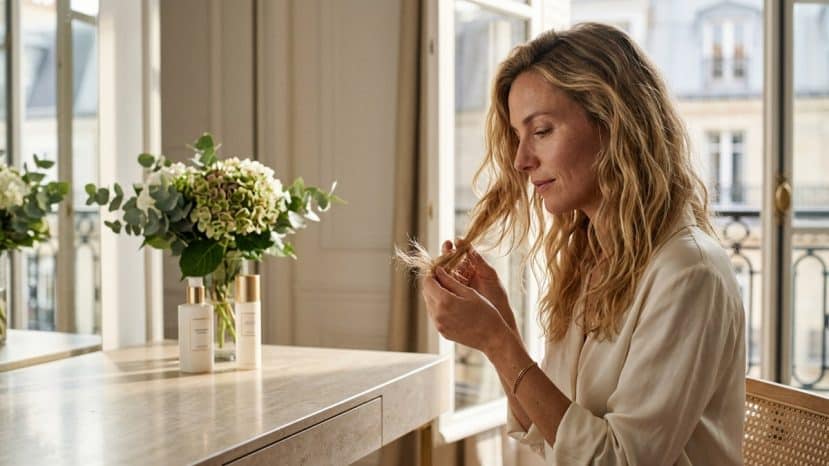


Every September, the same realisation hits in front of the mirror: lengths are dull, ends are brittle, and hair seems to have lost all its vitality after weeks of exposure to sun, salt and chlorine. Yet what many people don’t realise is that certain everyday habits make damaged hair worse instead of helping it recover. Célia, a hair expert on Instagram under the account @lesperlesdebrunette with 253,000 followers, has identified five very common mistakes we make without even noticing.
Brushing and washing: two key steps for damaged hair on the mend
Brushing is probably the most automatic gesture of the day. Yet starting from the roots to detangle your hair is a frequent mistake that weakens the hair fibre even further. By pulling through knots from the top, you cause breakage all the way down the length. The right method is to start at the ends, then work your way gradually up towards the roots. This simple change protects the lengths, especially when hair is dry or very tangled after summer.
Washing also deserves special attention. Scrubbing the entire head of hair with shampoo is not necessary to get a clean result. On the contrary, this habit damages lengths that are already fragile. Célia recommends concentrating the shampoo on the scalp and massaging specifically there. The lengths themselves don’t need to be scrubbed, they rinse clean naturally when you wash the shampoo out.
Hair mask and towel: rethinking your post-shampoo routine
A hair mask is a precious ally for damaged hair after the aggressions of summer. But its effectiveness depends directly on how you apply it. Applying it to soaking-wet hair is a mistake to correct as a priority. Excess water dilutes the treatment and prevents it from properly penetrating the hair fibre. It’s better to gently squeeze out the hair before applying the mask, then concentrate it on the lengths and ends, where the need is greatest.
Next comes the towel-drying step. Vigorously rubbing your hair to speed up drying weakens the fibre and encourages frizz. For damaged hair trying to regain softness, the recommended alternative is to use a microfibre towel. Rather than rubbing in all directions, gently press the lengths to remove excess water, then wrap your hair in this gentler fabric.
The essential gestures for caring for weakened hair
- Detangle starting from the ends and working up towards the roots to prevent breakage.
- Concentrate shampoo on the scalp with gentle massaging movements, without scrubbing the lengths.
- Lightly squeeze out hair before applying a mask, keeping it focused on the lengths and ends.
- Swap a regular towel for a microfibre one and press rather than rub.
- Build a routine tailored to your own needs rather than copying someone else’s ready-made one.
Why one product range is never enough to repair damaged hair
After summer, damaged hair accumulates several problems at once: dryness, lack of shine, brittle ends, frizz. Yet we often go looking for the miracle product capable of fixing everything in a single application. This approach, however, falls short when faced with such varied needs.
Célia advises building what she calls an intelligent routine, a combination of complementary treatments, each targeting a specific need. A repairing treatment, a colour-preservation product, an anti-frizz formula or a shine-boosting serum can all coexist within the same routine. What’s more, the key is not to replicate someone else’s routine, but to choose products based on your own hair type, its current condition and your personal goals.
Because damaged hair doesn’t all respond the same way. What works for fine, colour-treated hair won’t necessarily suit thick, curly hair. Adapting your routine to your real needs, rather than banking on a one-size-fits-all solution, remains the most effective approach to getting your hair back in shape by autumn 2026.